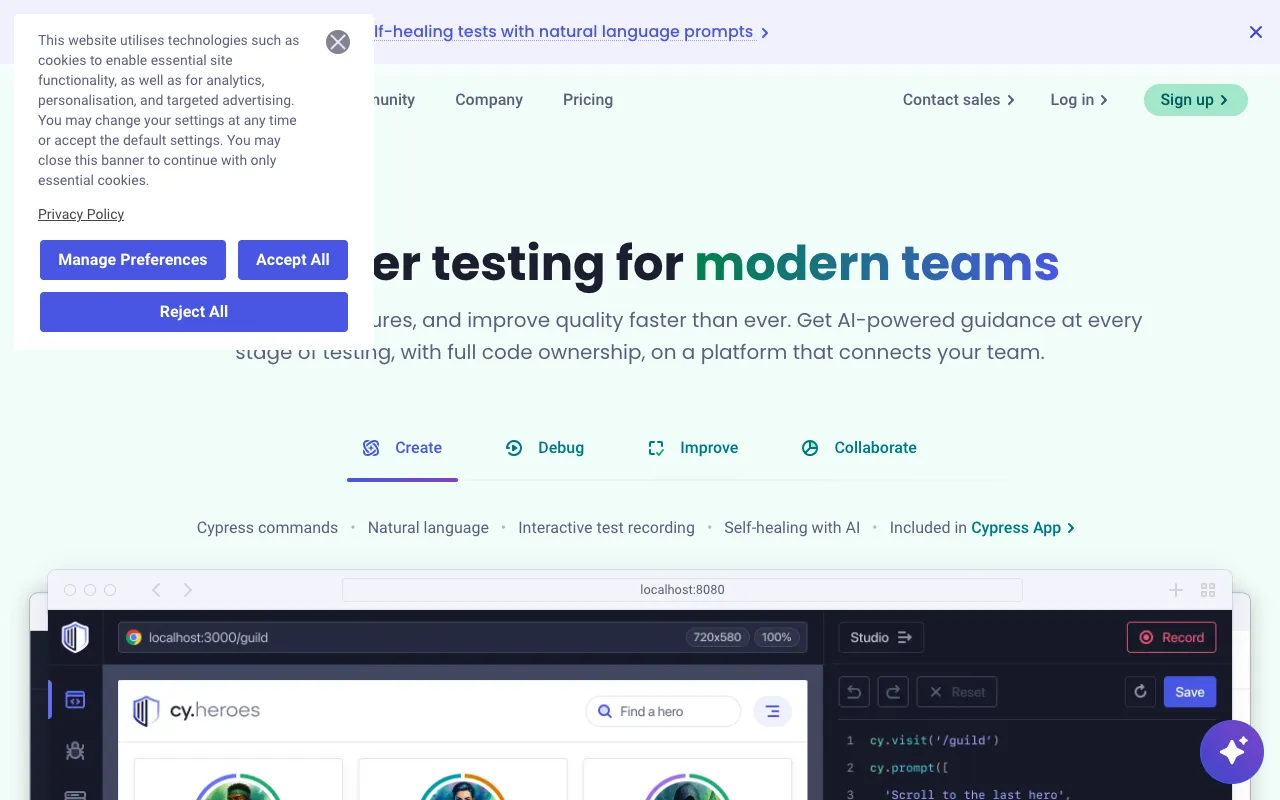
Cypress – The Definitive End-to-End Testing Framework
Cypress redefines front-end testing for web developers. As a complete end-to-end (E2E) testing solution, it addresses the core pain points of traditional testing tools by running directly inside the browser. This architecture provides developers with unparalleled control, enabling them to write faster, more reliable, and debuggable tests for React, Vue, Angular, and any other web technology. It's the testing tool built by developers, for developers.
What is Cypress?
Cypress is a modern, open-source testing framework designed specifically for end-to-end testing of web applications. Unlike Selenium-based tools that operate outside the browser, Cypress executes in the same run loop as your application. This fundamental difference provides native access to every element, network request, and browser event, resulting in tests that are significantly more stable, faster to execute, and dramatically easier to debug. It's the tool of choice for developers who value a streamlined, productive testing workflow.
Key Features of Cypress
Real-Time Reloads & Automatic Waiting
Cypress automatically waits for commands and assertions before moving on. No more flaky tests from arbitrary `sleep()` commands. Combined with its real-time reloading feature, you see test commands execute instantly in your app as you write them, creating a highly interactive and productive development loop.
Time Travel Debugging
Debug failed tests with precision. Cypress takes snapshots as your tests run. Hover over commands in the Command Log to see exactly what happened at each step, including DOM state, network requests, and any console messages. This eliminates the guesswork from test failures.
Network Traffic Control
Stub and intercept network requests at the browser level without touching your server. Test edge cases like slow 3G connections, simulate API failures, or mock backend responses to ensure your front-end logic is robust under all conditions.
Consistent Results & Screenshots/Videos
Cypress provides consistent, deterministic test results. It automatically captures screenshots on failure and can record full videos of your test runs, making it invaluable for CI/CD pipelines and post-mortem analysis of integration failures.
Who Should Use Cypress?
Cypress is ideal for front-end developers, full-stack engineers, and QA professionals working on modern JavaScript applications. It's particularly powerful for teams practicing Test-Driven Development (TDD) or looking to integrate robust E2E testing into their CI/CD pipeline. Whether you're building a single-page application (SPA) with React, a server-side rendered app with Next.js, or a traditional multi-page site, Cypress provides the tools to ensure your user flows work perfectly.
Cypress Pricing and Free Tier
Cypress offers a powerful, fully-featured open-source core that is completely free forever for individual use and small teams. This includes the Test Runner, Dashboard Service for recording limited test runs, and all core testing capabilities. For enterprise teams requiring advanced features like intelligent test orchestration, parallelization, and scalable analytics, Cypress offers paid Cloud plans. The generous free tier makes it accessible for every developer to start building a comprehensive testing suite at no cost.
Common Use Cases
- Testing user authentication flows and protected routes in a React application
- Validating complex form submissions and multi-step wizards in Vue.js
- Ensuring critical e-commerce checkout processes work flawlessly across browsers
Key Benefits
- Drastically reduces test flakiness with automatic waiting and retry-ability, leading to more reliable CI/CD pipelines.
- Improves developer velocity by providing a real-time, visual debugging environment that integrates with your normal workflow.
Pros & Cons
Pros
- Superior developer experience with an intuitive API and fantastic debugging tools.
- Tests run significantly faster and are more reliable than traditional Selenium-based frameworks.
- Comprehensive documentation and a large, active community for support.
- Native access to browser DevTools and network layer for powerful test scenarios.
Cons
- Currently only supports testing in Chromium-based browsers (Chrome, Edge, Electron) and Firefox.
- Cannot drive two browsers at once for testing multi-user interactions.
- The architecture requires tests to be written in JavaScript/TypeScript.
Frequently Asked Questions
Is Cypress free to use?
Yes, the core Cypress testing framework is open-source and completely free for unlimited use. This includes the Test Runner and essential features for writing and running tests locally. Paid Cloud plans are available for teams needing advanced dashboard features, parallelization, and analytics.
Is Cypress good for testing modern JavaScript frameworks?
Absolutely. Cypress is arguably the best testing tool available for modern JavaScript frameworks like React, Vue, Angular, and Svelte. Its architecture is designed for the dynamic nature of single-page applications, providing stable selectors and seamless integration with component lifecycles and state management.
Can Cypress test backend APIs?
While Cypress is primarily an end-to-end testing tool for the front-end, it excels at testing the integration between your front-end and backend. You can make API calls, intercept and stub network requests, and assert on responses. However, for pure API or unit testing, dedicated tools like Jest or Supertest may be more appropriate.
Conclusion
For web developers prioritizing a robust, modern, and enjoyable testing workflow, Cypress stands as the clear leader in end-to-end testing. It transforms testing from a chore into an integrated part of the development process. By eliminating flakiness, providing unparalleled debugging, and running with the speed of native code, it empowers teams to ship higher-quality software with confidence. If you're building for the web, your testing suite deserves Cypress.