Go back
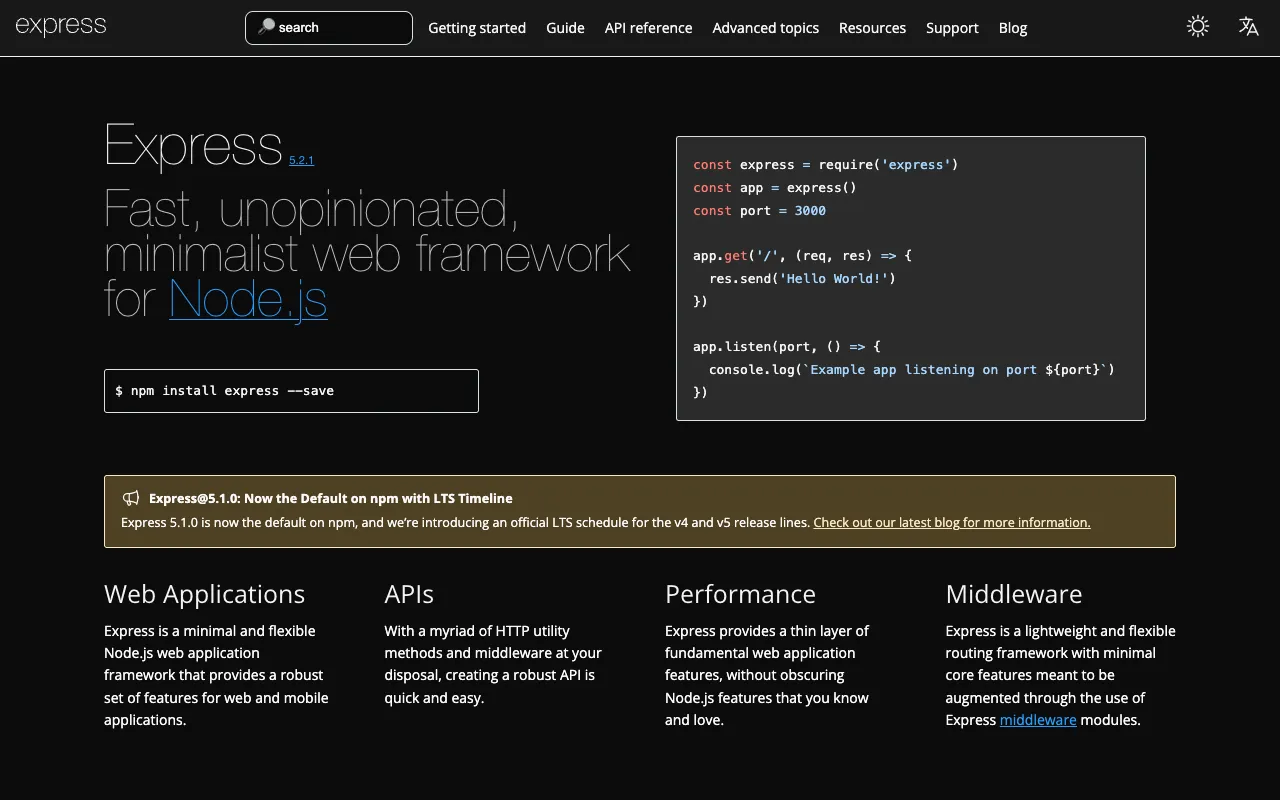
Image of Express.js – The Premier Node.js Web Framework for Developers

Express.js – The Premier Node.js Web Framework for Developers

Express.js stands as the most popular and foundational web application framework for Node.js, empowering developers to build everything from simple single-page apps to complex enterprise-grade APIs and mobile backends. Its minimalist philosophy provides the essential tools for web and HTTP server development without imposing rigid structures, offering unparalleled flexibility and speed. At NutterTools.dev, we recognize Express.js as an indispensable tool in any web developer's toolkit, forming the robust backbone for countless modern web applications.

What is Express.js?

Express.js is a fast, unopinionated, and minimalist web framework for Node.js. It provides a thin layer of fundamental web application features, simplifying the process of building single-page, multi-page, and hybrid web applications and robust APIs. Unlike more opinionated frameworks, Express gives developers the freedom to structure their applications as they see fit while handling the complexities of HTTP requests, routing, and middleware. It's the de facto standard server framework for the Node.js ecosystem, acting as the foundation for many other tools and frameworks.

Key Features of Express.js

Robust Routing

Express provides a powerful, intuitive routing mechanism that allows developers to define endpoints (URIs) and handle HTTP requests (GET, POST, PUT, DELETE, etc.) with precise control. Routes can include parameters, query strings, and wildcards, making it easy to build clean, RESTful APIs and dynamic web pages.

Middleware Architecture

The middleware system is the heart of Express. Middleware functions have access to the request and response objects and can execute code, make changes, end the request-response cycle, or call the next middleware. This allows for modular functionality like authentication, logging, parsing request bodies (JSON, URL-encoded), and serving static files.

High Performance

Built on Node.js's non-blocking I/O model, Express handles numerous concurrent connections with minimal overhead. Its minimalist core ensures fast execution, making it ideal for data-intensive real-time applications and high-traffic APIs where performance is critical.

Template Engine Integration

While primarily used for APIs, Express seamlessly integrates with template engines like Pug, EJS, and Handlebars. This allows developers to dynamically generate HTML on the server-side for rendering full-stack web applications, providing flexibility in how content is delivered to the client.

Who Should Use Express.js?

Express.js is ideal for JavaScript/Node.js developers at all levels who need to create server-side logic. Backend developers use it to build RESTful APIs for frontend frameworks like React, Vue, or Angular. Full-stack developers leverage it for monolithic applications. Startups and enterprises choose it for its scalability and vast ecosystem. It's also perfect for developers learning backend development due to its straightforward concepts and extensive documentation. If you need a flexible, performant foundation for a web server without the constraints of a full-stack framework, Express is the premier choice.

Express.js Pricing and Free Tier

Express.js is 100% free and open-source software released under the permissive MIT License. There are no fees, subscriptions, or tiered plans. The entire framework, its core features, and the massive ecosystem of compatible middleware and plugins are freely available for use in personal projects, commercial applications, and enterprise systems. This zero-cost model, combined with its robust capabilities, is a key reason for its widespread adoption and dominance in the Node.js landscape.

Common Use Cases

Key Benefits

Pros & Cons

Pros

  • Extremely lightweight and fast with minimal performance overhead
  • Unopinionated design offers maximum architectural flexibility
  • Vast npm ecosystem with thousands of compatible middleware packages
  • Simple learning curve for developers familiar with JavaScript and Node.js
  • Proven in production at massive scale by companies like Uber, PayPal, and IBM

Cons

  • Minimal structure can lead to disorganized code in large projects without discipline
  • Requires manual integration of many features (like authentication) that are built into full-stack frameworks
  • Asynchronous error handling can be more complex compared to synchronous frameworks

Frequently Asked Questions

Is Express.js free to use?

Yes, Express.js is completely free and open-source. It is released under the MIT License, which allows for unrestricted use in personal, commercial, and enterprise projects without any cost or licensing fees.

Is Express.js good for building APIs?

Absolutely. Express.js is arguably the best Node.js framework for building RESTful and GraphQL APIs. Its simple routing, middleware support for parsing JSON/XML, and ease of integrating with databases make it the industry-standard choice for API development in the Node.js ecosystem.

What is the difference between Express.js and Nest.js?

Express.js is a minimal, unopinionated framework providing core HTTP server functionality. Nest.js is a progressive, opinionated framework built on top of Express (or Fastify) that provides an out-of-the-box architecture with dependency injection, modules, and strong typing, often compared to Angular for the backend. Choose Express for flexibility, Nest for structure and TypeScript.

Do I need to know Node.js to use Express.js?

Yes, a solid understanding of core Node.js concepts—particularly the HTTP module, callbacks/promises/async-await, and the CommonJS module system—is essential before learning Express. Express builds upon these Node.js fundamentals to simplify web server creation.

Conclusion

For developers seeking a powerful, flexible, and performant foundation for Node.js web applications, Express.js remains the undisputed leader. Its minimalist approach empowers you to build exactly what you need, from simple prototypes to massively scalable production systems, without unnecessary bloat. While it requires more initial architectural decisions than opinionated frameworks, the payoff is unparalleled control and a deep understanding of your application's inner workings. For building robust APIs, server-rendered web apps, or any custom backend service, Express.js is a foundational tool that belongs in every web developer's arsenal.