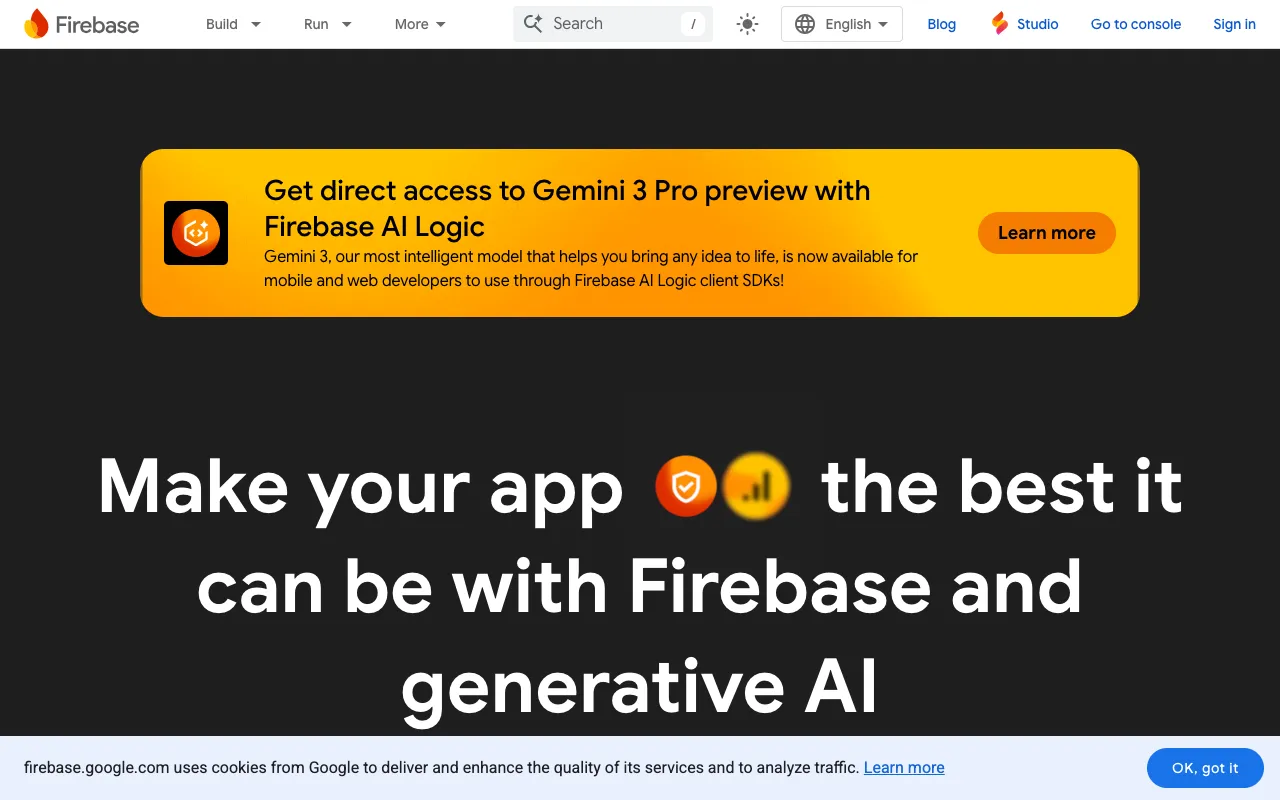
Firebase – The Ultimate Backend Platform for Web Developers
Firebase, Google's premier Backend-as-a-Service (BaaS) platform, empowers web developers to build, release, and scale applications with unprecedented speed. By abstracting complex server infrastructure, Firebase provides a comprehensive suite of managed services—including authentication, realtime NoSQL databases, cloud hosting, and serverless functions—allowing developers to focus on creating exceptional user experiences. It's the go-to solution for startups, indie developers, and enterprises looking to accelerate development cycles and reduce operational overhead.
What is Firebase?
Firebase is a comprehensive application development platform acquired and developed by Google. It functions as a Backend-as-a-Service (BaaS), providing a fully managed, serverless backend for web and mobile applications. At its core, Firebase removes the need for developers to manage their own servers, databases, and complex infrastructure. Instead, it offers integrated, scalable services like Firestore (a flexible NoSQL database), Firebase Authentication, Cloud Functions for serverless logic, and Firebase Hosting for fast, secure web deployments. It's designed to help developers go from idea to launch faster than ever before.
Key Features of Firebase
Cloud Firestore Database
Firestore is a flexible, scalable NoSQL cloud database for storing and syncing data in real-time. It offers automatic multi-region replication, strong consistency, and expressive querying. Its real-time listeners enable you to build collaborative and reactive web applications where UI updates automatically as data changes, without needing to refresh the page.
Firebase Authentication
Implement secure user authentication in minutes with a drop-in solution. Firebase Auth supports email/password, phone authentication, and federated identity providers like Google, Facebook, Twitter, and GitHub. It handles the entire auth flow, including user management and secure token generation, drastically reducing development time and security risks.
Firebase Hosting
Deploy your web app's static assets (HTML, CSS, JS) and dynamic content with a single command. Firebase Hosting provides production-grade web hosting with a global CDN, SSL certificates automatically provisioned, and one-click rollbacks. It's optimized for single-page apps (SPAs) and static sites, delivering content with low latency worldwide.
Cloud Functions for Firebase
Run backend code in response to events triggered by Firebase features and HTTPS requests. These serverless functions are your app's backend logic, allowing you to automate tasks, process data, integrate with third-party services, or extend Firebase's capabilities without managing servers. They scale automatically and you only pay for the compute time you use.
Realtime Database
Firebase's original realtime JSON database enables you to build rich, collaborative applications by syncing data across all clients in milliseconds. It's ideal for applications that require low-latency updates, such as chat apps, live dashboards, and multiplayer games, providing a persistent connection to your data.
Who Should Use Firebase?
Firebase is ideal for a wide range of developers and projects. Startup founders and indie developers benefit from its rapid prototyping capabilities and generous free tier. Full-stack and frontend developers can build complete applications without deep backend expertise. Product teams needing to launch MVPs quickly will find its integrated services invaluable. It's also powerful for enterprises building real-time applications like collaborative tools, live dashboards, or social features. While excellent for web apps, its seamless integration with iOS and Android makes it a top choice for cross-platform projects.
Firebase Pricing and Free Tier
Firebase operates on a flexible, pay-as-you-go pricing model with a very generous free tier called the 'Spark Plan.' This free tier is perfect for development, prototyping, and small production apps, offering daily quotas for services like database reads/writes, authentication, hosting bandwidth, and function invocations. As your app scales, you move to the 'Blaze Plan' (pay-as-you-go), where you only pay for the resources you use beyond the free tier limits. This model makes Firebase extremely cost-effective, allowing projects to start for free and scale predictably with usage.
Common Use Cases
- Building a real-time collaborative web application like a project management tool or live document editor
- Creating a single-page application (SPA) with user authentication and a cloud database
- Developing a progressive web app (PWA) with offline capabilities and fast hosting
- Prototyping a startup MVP quickly without backend server management
Key Benefits
- Dramatically reduces time-to-market by providing pre-built, scalable backend services
- Eliminates server management, database administration, and infrastructure DevOps overhead
- Enables building of real-time, reactive user interfaces with synchronized data across clients
- Provides a unified platform for both web and mobile app development with shared backend logic
Pros & Cons
Pros
- Extremely fast setup and prototyping with a comprehensive suite of integrated services
- Generous free tier (Spark Plan) suitable for development and small-scale production
- Backed by Google Cloud Platform, ensuring reliability, security, and global scalability
- Excellent real-time data synchronization capabilities for interactive apps
- Seamless integration with other Google services and popular frontend frameworks (React, Angular, Vue)
Cons
- Vendor lock-in can be a concern as your app's logic becomes tightly coupled to Firebase services
- Complex queries can be more challenging compared to traditional SQL databases
- Costs for the Blaze Plan can become significant for applications with very high, sustained traffic or data operations
Frequently Asked Questions
Is Firebase free to use?
Yes, Firebase offers a permanently free tier called the Spark Plan. This plan includes daily quotas for core services like database operations, authentication, hosting, and cloud functions, which are sufficient for development, testing, and small production applications. For larger scale, you upgrade to the pay-as-you-go Blaze Plan.
Is Firebase good for web development?
Absolutely. Firebase is one of the best platforms for modern web development. It provides essential backend services like authentication, a realtime database (Firestore), serverless functions, and fast global hosting—all optimized for building single-page applications (SPAs), progressive web apps (PWAs), and dynamic websites. It allows frontend developers to build full-stack applications efficiently.
What is the difference between Firebase and building my own backend?
Building your own backend requires you to provision servers, configure databases, implement security, set up scaling, and handle ongoing maintenance. Firebase provides all these as managed, auto-scaling services. The key difference is development speed and operational complexity: Firebase lets you focus on application features, while a custom backend requires significant DevOps investment.
Can I use Firebase with React or Vue.js?
Yes, Firebase has excellent official SDKs and strong community support for all major frontend frameworks including React, Vue.js, and Angular. Integration is straightforward, and many developers use Firebase as the backend for their React or Vue single-page applications, leveraging realtime data and authentication seamlessly.
Conclusion
For web developers seeking to build full-featured applications with speed and scalability, Firebase stands as a top-tier Backend-as-a-Service platform. Its integrated suite of services—from Firestore's realtime database to hassle-free authentication and global hosting—dramatically reduces development time and infrastructure complexity. While considerations like vendor lock-in exist, the productivity gains, robust free tier, and Google Cloud backing make Firebase an exceptional choice for prototyping MVPs, building real-time web apps, and scaling projects efficiently. It empowers developers to turn ideas into launched products faster than traditional backend development allows.