MongoDB – Best NoSQL Database for Modern Web Developers
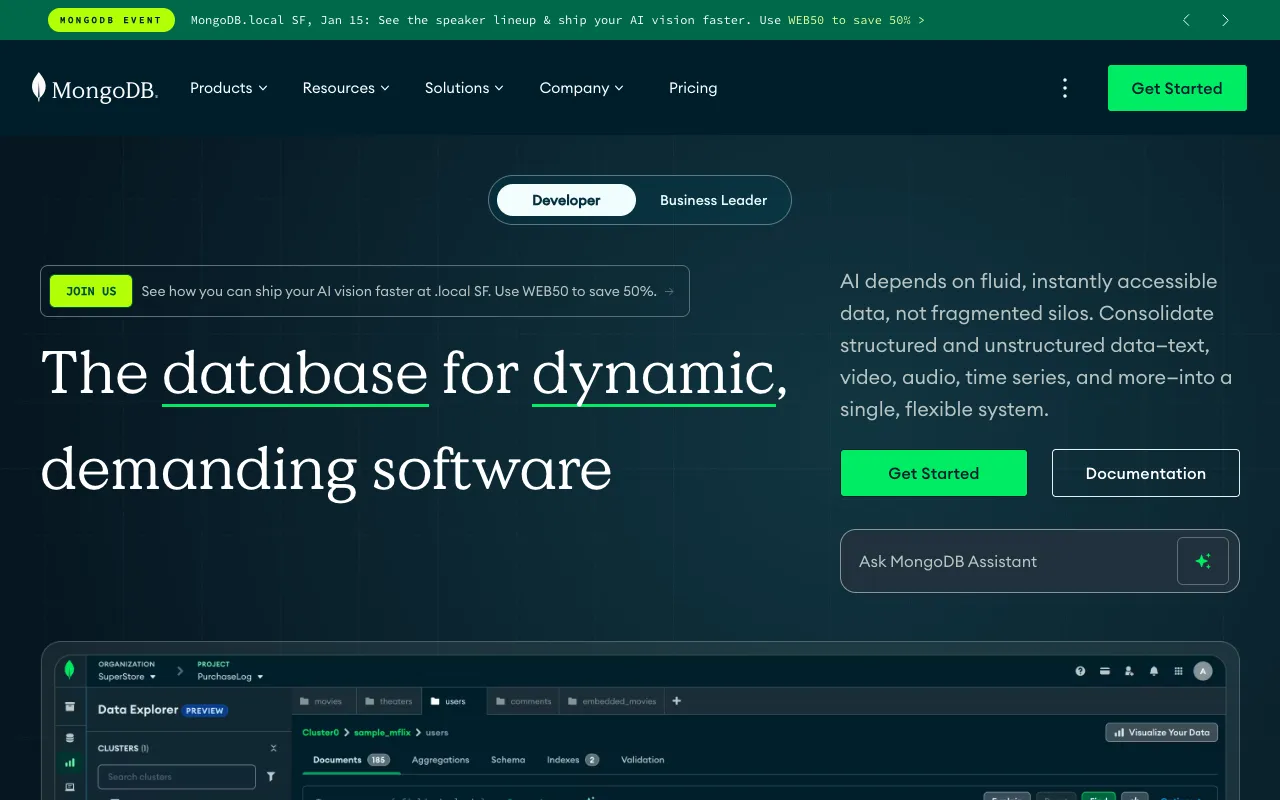
MongoDB is the premier document-oriented NoSQL database built for the way developers think and code. By storing data in flexible, JSON-like documents, it enables web developers to build and scale applications faster than traditional relational databases. Its intuitive design, horizontal scalability, and powerful querying make it the default database choice for modern web applications, from agile startups to global enterprises.
What is MongoDB?
MongoDB is a cross-platform, document-oriented database program classified as a NoSQL database. Unlike traditional SQL databases that use tables and rows, MongoDB stores data in flexible, JSON-like documents with dynamic schemas (BSON format). This 'document model' maps naturally to objects in application code, making data integration seamless for developers. It is open-source at its core, highly scalable, and designed to handle the diverse, unstructured, and rapidly evolving data requirements of contemporary web and mobile applications.
Key Features of MongoDB
Document-Oriented Storage
Store complex, hierarchical data as JSON-like documents. This schema flexibility allows for rapid iteration during development and accommodates evolving data structures without costly migrations, perfectly aligning with agile methodologies.
Powerful Query Language & Indexing
Execute rich, ad-hoc queries on documents using a powerful query language that supports filtering, sorting, aggregation, and geospatial queries. Full support for secondary indexes ensures high performance for any access pattern.
Horizontal Scalability with Sharding
Scale your database horizontally across multiple servers with built-in automatic sharding. Distribute data to handle massive increases in read/write traffic and dataset size, providing linear scalability for growing applications.
High Availability & Replication
Ensure data durability and application uptime with replica sets. MongoDB provides automatic failover and data redundancy, maintaining multiple copies of your data across servers for disaster recovery.
Aggregation Framework
Perform complex data transformations and analytics within the database using a powerful aggregation pipeline. Filter, group, reshape, and analyze your document data efficiently without extensive application-side processing.
Who Should Use MongoDB?
MongoDB is ideal for web developers, startups, and enterprises building modern applications where requirements evolve quickly. It's a perfect fit for projects involving content management, real-time analytics, Internet of Things (IoT), mobile apps, and user profile management. Developers frustrated with rigid SQL schemas or dealing with semi-structured data will find MongoDB's flexible model significantly accelerates development cycles and simplifies data modeling.
MongoDB Pricing and Free Tier
MongoDB offers a robust, perpetually free tier through MongoDB Atlas, its fully-managed global cloud database service. The free tier includes a shared cluster with 512 MB to 5 GB of storage, perfect for learning, prototyping, and small applications. For production workloads, MongoDB Atlas provides scalable paid tiers with dedicated resources, advanced security, and support. The open-source Community Edition is also available for self-hosting.
Common Use Cases
- Building a scalable real-time analytics dashboard for web applications
- Developing a flexible content management system (CMS) with evolving content types
- Creating a user profile store for a social media or e-commerce platform
- Managing product catalogs with variable attributes in an online store
- Storing and querying geospatial data for location-based services
Key Benefits
- Accelerates development time by aligning the database model with application objects
- Provides effortless scalability to handle massive user growth and data volume
- Increases developer productivity with an intuitive API and extensive driver support
- Reduces operational overhead with fully-managed cloud options (Atlas)
- Enables handling of complex, hierarchical, and polymorphic data with ease
Pros & Cons
Pros
- Flexible schema design enables rapid prototyping and iteration
- Excellent horizontal scalability for high-traffic applications
- Strong developer experience with native drivers for all major languages
- Comprehensive managed service (Atlas) reduces DevOps burden
- Powerful aggregation framework for in-database analytics
Cons
- Lack of native multi-document ACID transactions in early versions (now supported)
- Can consume more storage space than normalized relational databases
- Complex joins are less straightforward than in SQL databases
- Requires careful schema design for optimal performance despite flexibility
Frequently Asked Questions
Is MongoDB free to use?
Yes, MongoDB offers a generous free tier through MongoDB Atlas with up to 5GB of storage. The open-source Community Server is also free for self-managed deployments, making it accessible for all development stages.
Is MongoDB a good database for web development?
Absolutely. MongoDB is one of the best databases for modern web development due to its flexible document model, which maps directly to JSON used in web APIs, its scalability to handle web-scale traffic, and its developer-friendly query API. It's particularly strong for real-time applications, CMS platforms, and projects with evolving data requirements.
What is the difference between MongoDB and SQL databases?
The core difference is the data model. SQL databases (like MySQL, PostgreSQL) use a rigid, table-based schema with rows and columns, requiring predefined structure. MongoDB uses a flexible, document-based schema (JSON/BSON), allowing fields to vary per document. This makes MongoDB more agile for unstructured or semi-structured data and faster for iterative development.
Can MongoDB handle complex transactions?
Yes. Modern MongoDB (version 4.0+) supports multi-document ACID transactions, providing the same data integrity guarantees for complex operations that traditional relational databases offer. This makes it suitable for a wider range of critical financial or operational applications.
Conclusion
For web developers seeking to build scalable, high-performance applications without the constraints of rigid schemas, MongoDB stands as a leading choice. Its document model offers unparalleled flexibility, its cloud service (Atlas) simplifies operations, and its powerful feature set supports everything from simple prototypes to global enterprise systems. Whether you're launching a startup MVP or scaling an existing platform, MongoDB provides the database foundation to innovate faster and grow confidently.