Go back
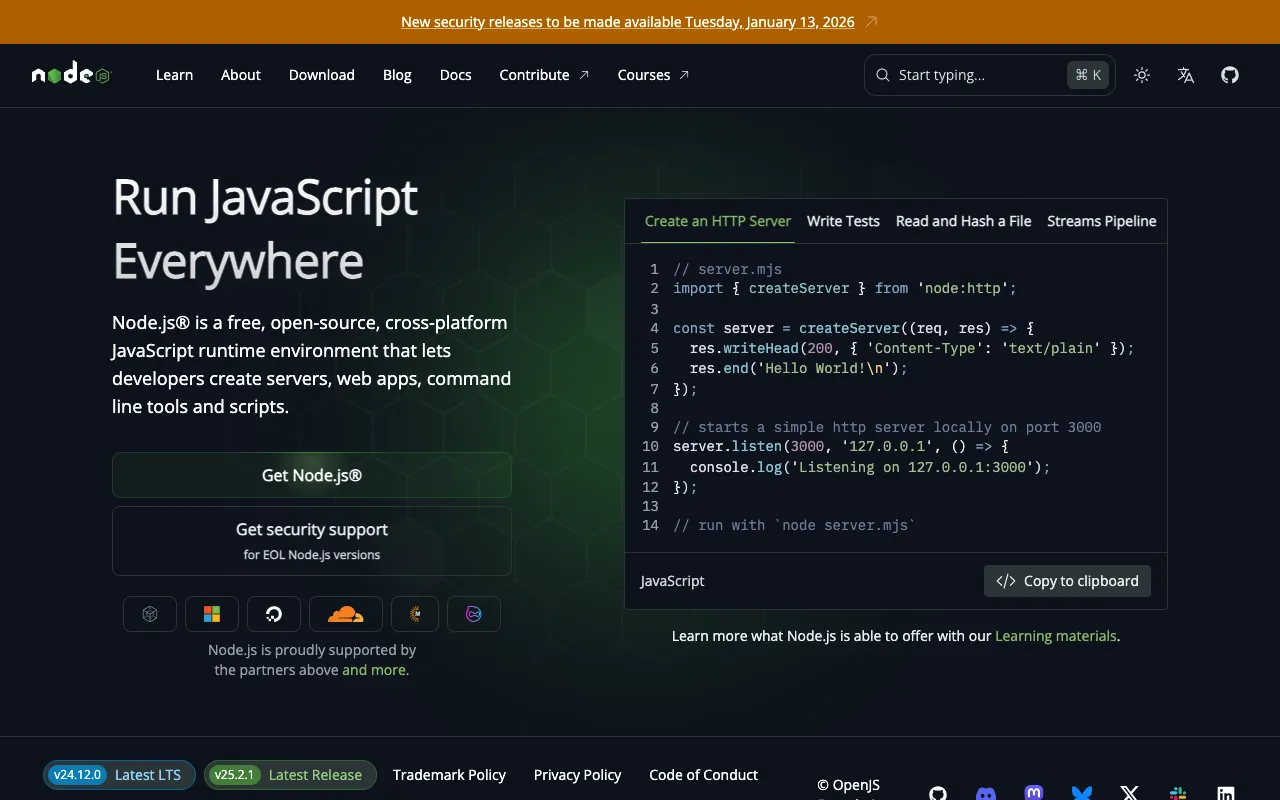
Image of Node.js – The Essential JavaScript Runtime for Backend Development

Node.js – The Essential JavaScript Runtime for Backend Development

Node.js revolutionized web development by bringing JavaScript to the server. As an open-source, cross-platform runtime environment built on Chrome's V8 engine, Node.js enables developers to build fast, scalable network applications and APIs with a unified JavaScript language stack. It's the cornerstone of modern backend development, powering everything from REST APIs and microservices to real-time applications and serverless functions.

What is Node.js?

Node.js is a powerful, open-source JavaScript runtime environment that executes JavaScript code outside of a web browser. By leveraging the high-performance V8 JavaScript engine from Google Chrome, Node.js provides a non-blocking, event-driven architecture ideal for data-intensive real-time applications. It allows developers to use JavaScript—a language traditionally confined to the browser—for server-side scripting, creating a unified development paradigm across the entire web stack. This paradigm shift has made Node.js the backbone of countless modern web applications, from startups to enterprise-scale systems.

Key Features of Node.js

Non-Blocking, Asynchronous I/O

Node.js uses an event-driven, non-blocking I/O model that makes it exceptionally lightweight and efficient. This architecture allows a single Node.js server to handle thousands of concurrent connections without creating threads for each request, leading to high throughput and scalability for I/O-heavy applications like chat apps, live notifications, and API gateways.

Unified JavaScript Stack

Developers can write both client-side and server-side code in JavaScript, reducing context switching and enabling code reuse. This full-stack JavaScript approach streamlines development, simplifies hiring, and allows for shared libraries and tools across the entire application.

NPM (Node Package Manager)

Node.js comes bundled with npm, the world's largest ecosystem of open-source libraries. With over a million packages available, developers can quickly integrate functionality—from web frameworks like Express.js to utility libraries—dramatically accelerating development speed and reducing boilerplate code.

High Performance with V8 Engine

Built on Chrome's V8 JavaScript engine, Node.js compiles JavaScript directly to native machine code, resulting in exceptional execution speed. Continuous improvements from the V8 team ensure Node.js applications benefit from cutting-edge JavaScript performance optimizations.

Who Should Use Node.js?

Node.js is ideal for developers and teams building data-intensive, real-time applications that require high concurrency and scalability. Frontend developers expanding into full-stack roles benefit immensely from using a familiar language. Startups and enterprises creating APIs, microservices, streaming platforms, IoT backends, and single-page application (SPA) backends will find Node.js particularly effective. It's also a perfect choice for projects where rapid prototyping and a vast ecosystem of pre-built modules are critical to meeting deadlines.

Node.js Pricing and Free Tier

Node.js is completely free and open-source, released under an MIT license. There are no licensing fees, subscription costs, or tiered pricing plans. The runtime itself, along with its core modules and the npm registry for public packages, is free for any use—personal, commercial, or enterprise. This zero-cost model, combined with its powerful capabilities, makes Node.js one of the most accessible and cost-effective technologies for building production-grade applications.

Common Use Cases

Key Benefits

Pros & Cons

Pros

  • Unmatched speed and performance for I/O-bound operations and real-time apps
  • Vast ecosystem with npm provides solutions for virtually any development need
  • Perfect for JavaScript developers to become full-stack without learning a new language
  • Lightweight and scalable, making it cost-effective for cloud deployment

Cons

  • Not ideal for CPU-intensive tasks like video encoding or complex scientific computing, as it can block the single-threaded event loop
  • Callback-heavy code ("callback hell") can lead to complexity, though modern async/await syntax largely mitigates this
  • The rapid evolution of the ecosystem can sometimes lead to dependency management challenges

Frequently Asked Questions

Is Node.js free to use?

Yes, Node.js is completely free and open-source. It is released under the permissive MIT license, which allows for unrestricted use, modification, and distribution in both personal and commercial projects without any cost.

Is Node.js good for backend development?

Absolutely. Node.js is one of the leading technologies for modern backend development. Its non-blocking architecture is exceptionally well-suited for building scalable network applications, APIs, and microservices. Major companies like Netflix, PayPal, and LinkedIn use Node.js in their backend stacks to handle high traffic efficiently.

What is the difference between Node.js and JavaScript?

JavaScript is the programming language itself, originally designed to run in web browsers. Node.js is a runtime environment that allows you to execute JavaScript code on a server or computer outside of a browser. Think of JavaScript as the language and Node.js as the engine that runs it on the server-side.

Can I build a full website with just Node.js?

While Node.js can serve HTML files and handle backend logic, it's typically used in conjunction with web frameworks (like Express.js) and frontend libraries (like React or Vue) to build full-stack applications. Node.js handles the server, API, and business logic, while you use other technologies for the user interface, though frameworks like Next.js provide a more integrated full-stack experience with Node.js.

Conclusion

Node.js stands as a foundational technology in the web developer's toolkit. Its ability to unify the development stack under JavaScript, combined with its exceptional performance for I/O-bound tasks and its massive, vibrant ecosystem, makes it an indispensable choice for modern backend development. Whether you're building a real-time application, a scalable API, or a suite of microservices, Node.js provides the performance, efficiency, and developer ergonomics needed to succeed in today's fast-paced digital landscape. For any developer or team serious about building efficient, scalable network applications, mastering Node.js is not just an option—it's a strategic advantage.