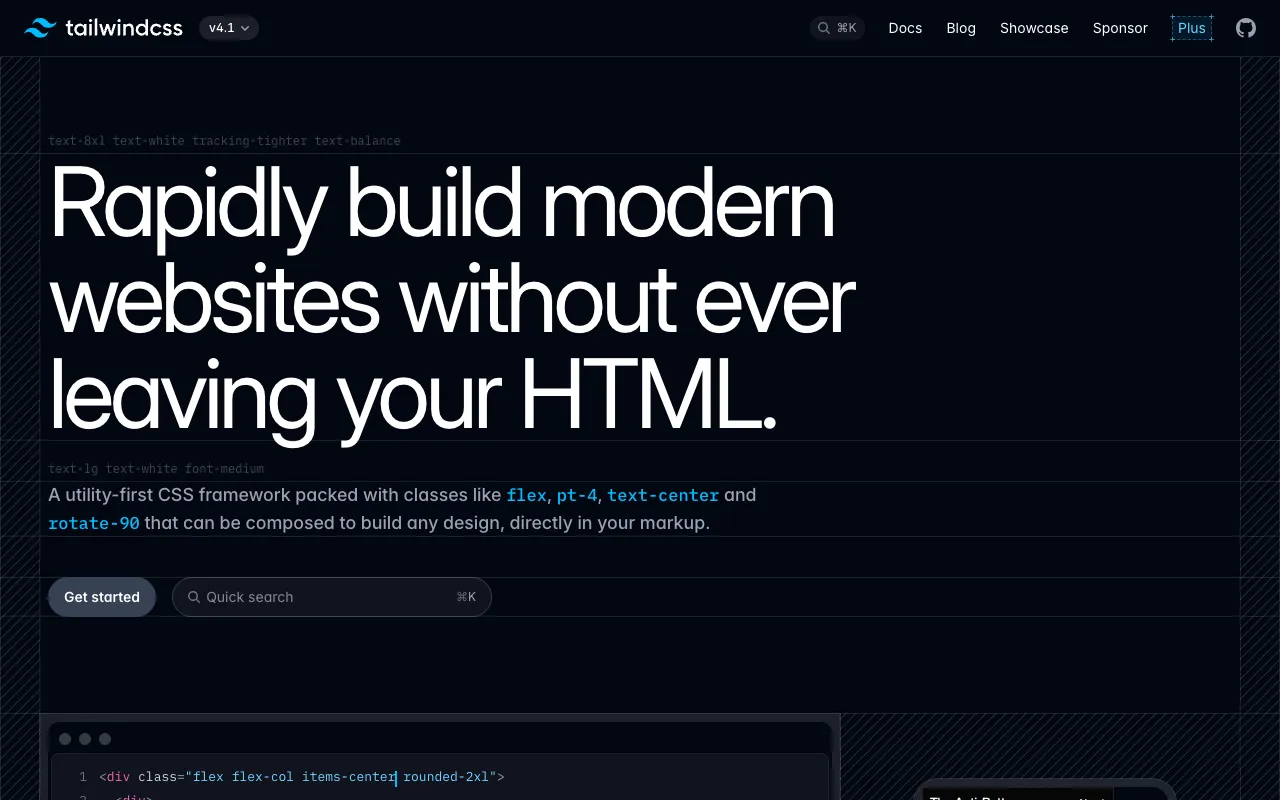
Tailwind CSS – The Best Utility-First CSS Framework for Web Developers
Tailwind CSS revolutionizes front-end development by providing a low-level utility-first framework for building completely custom designs without writing traditional CSS. Instead of pre-designed components, Tailwind offers a comprehensive set of single-purpose utility classes you apply directly in your HTML. This approach gives developers unparalleled design control, speeds up the development process, and eliminates the need for context-switching between HTML and CSS files. It’s the go-to tool for developers who want to ship responsive, accessible, and beautiful UIs faster than ever before.
What is Tailwind CSS?
Tailwind CSS is a highly customizable, utility-first CSS framework. Its core philosophy is to provide building blocks (utility classes) instead of opinionated, pre-styled components. You style elements by applying these atomic classes directly in your HTML, enabling you to construct any design directly within your markup. This methodology eliminates the need to invent class names, reduces CSS bloat, and creates a more maintainable, consistent codebase. It’s designed for developers who prioritize flexibility, performance, and developer experience over out-of-the-box component libraries.
Key Features of Tailwind CSS
Utility-First Workflow
Tailwind provides thousands of tiny, single-purpose utility classes for everything from spacing and typography to colors and flexbox. This allows you to build complex, custom component designs entirely in your HTML, drastically reducing development time and cognitive load.
Fully Responsive Design
Every utility class in Tailwind is available with responsive variants (like `md:`, `lg:`). This makes building mobile-first, responsive interfaces intuitive and declarative, without writing custom media queries.
Extensive Customization
Tailwind is designed to be deeply customizable. You can easily extend the default configuration (like colors, spacing, fonts) in a single `tailwind.config.js` file to match your project's unique design system perfectly.
Just-in-Time (JIT) Engine
Tailwind's revolutionary JIT mode generates your CSS on-demand as you author your templates. This leads to lightning-fast build times, enables arbitrary value support (like `top-[117px]`), and results in the smallest possible production CSS file.
Developer Experience
With features like IntelliSense autocompletion in popular code editors, built-in PurgeCSS for removing unused styles, and excellent documentation, Tailwind is built to maximize developer productivity and satisfaction.
Who Should Use Tailwind CSS?
Tailwind CSS is ideal for front-end developers, UI engineers, and full-stack developers who value design control and development speed. It's perfect for teams building custom design systems, SaaS applications, marketing websites, or any project where a unique, branded UI is a priority. It's less suited for developers who want a 'drag-and-drop' component library with minimal styling decisions.
Tailwind CSS Pricing and Free Tier
Tailwind CSS is completely free and open-source under the MIT license. The core framework, its extensive utility classes, the JIT engine, and all official plugins can be used in any personal or commercial project at no cost. The creators also offer premium paid products like Tailwind UI (a component library) and Headless UI (unstyled, accessible UI components), but the core framework itself remains 100% free forever.
Common Use Cases
- Building a custom design system for a SaaS application
- Rapidly prototyping and iterating on responsive landing page designs
- Creating consistent, accessible user interfaces in React, Vue, or other JavaScript frameworks
Key Benefits
- Accelerate UI development by composing designs directly in HTML, eliminating context-switching and custom CSS files.
- Achieve pixel-perfect, fully custom designs that match brand guidelines without fighting against pre-built component styles.
- Generate smaller, more performant CSS bundles by purging all unused utility classes from production builds.
Pros & Cons
Pros
- Unmatched flexibility and control over the final visual design.
- Significantly faster UI development workflow after the initial learning curve.
- Highly consistent and maintainable codebase with a constrained design system.
- Excellent performance with small, optimized CSS output in production.
Cons
- Initial learning curve for developers new to the utility-first methodology.
- HTML markup can become verbose with many applied utility classes.
- Requires familiarity with CSS concepts to use the utilities effectively.
Frequently Asked Questions
Is Tailwind CSS free to use?
Yes, Tailwind CSS is completely free and open-source. The core framework is licensed under MIT and can be used in any project, personal or commercial, without any cost. Paid products like Tailwind UI are separate, optional additions.
Is Tailwind CSS good for production websites?
Absolutely. Tailwind CSS is used by thousands of companies in production, including Netflix, Shopify, and GitHub. Its Just-in-Time mode and built-in purging ensure minimal, optimized CSS bundles, making it an excellent choice for high-performance, production-ready websites and applications.
How does Tailwind CSS compare to Bootstrap?
While Bootstrap is a component-based framework offering pre-styled UI kits, Tailwind CSS is utility-first, providing low-level building blocks for fully custom designs. Tailwind offers more design flexibility and control, whereas Bootstrap provides faster setup with ready-made components but less customization.
Does Tailwind CSS work with React, Vue, or Next.js?
Yes, Tailwind CSS integrates seamlessly with all modern JavaScript frameworks and meta-frameworks like React, Vue.js, Svelte, Next.js, and Nuxt.js. Its utility-class approach is framework-agnostic and works perfectly within JSX, Vue templates, and other component structures.
Conclusion
For web developers seeking a modern, efficient, and highly customizable approach to styling, Tailwind CSS stands out as a top-tier solution. Its utility-first paradigm empowers developers to build unique, responsive interfaces with remarkable speed and consistency. By eliminating the friction of traditional CSS and providing a powerful, configurable system, Tailwind CSS is not just a framework but a fundamental upgrade to the front-end development workflow. It is the definitive choice for developers who want to move fast without sacrificing design quality or control.