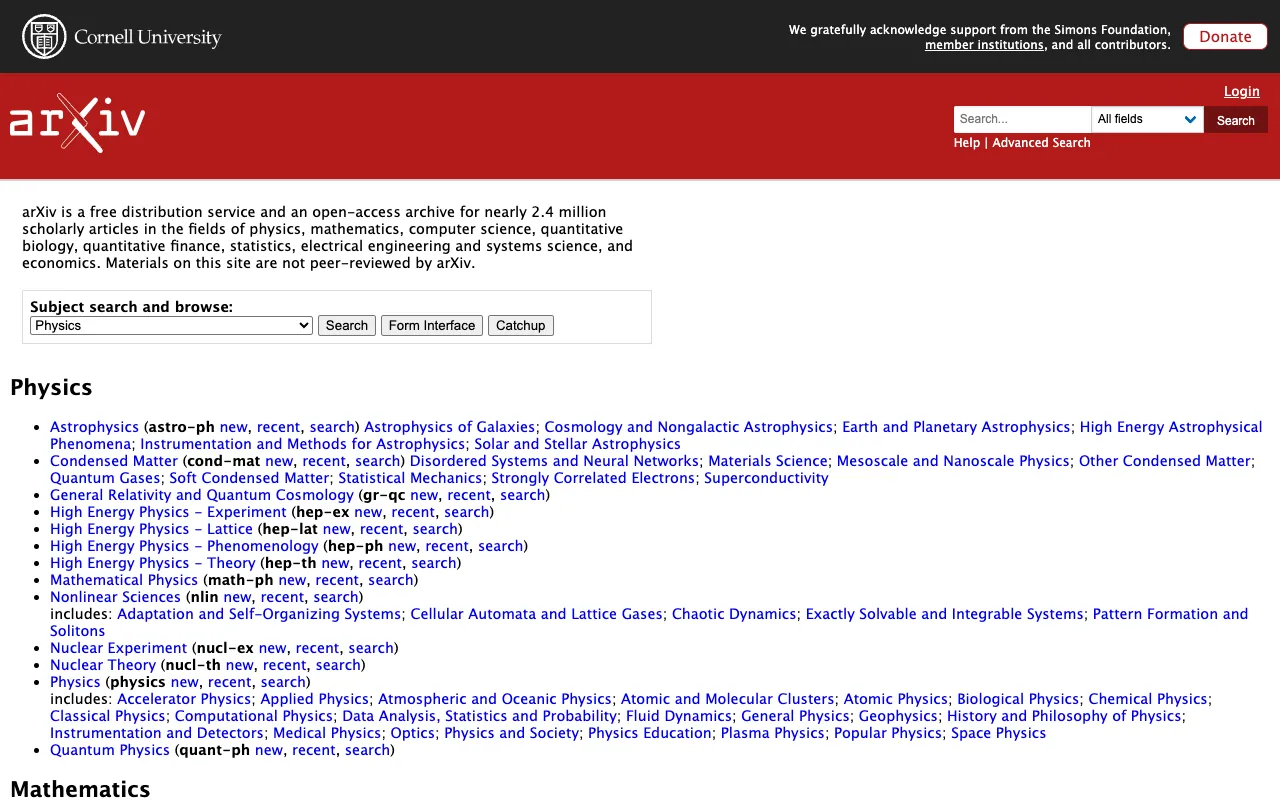
arXiv – The Essential Free Research Archive for AI Researchers
arXiv is the cornerstone of modern academic discovery for AI researchers, machine learning engineers, and computer scientists. This pioneering open-access repository provides instant, free access to over 2 million scholarly preprints—research papers published before formal peer review. For professionals and students at the cutting edge of artificial intelligence, natural language processing, and deep learning, arXiv is not just a tool; it's the primary pipeline for the latest breakthroughs, methodologies, and theoretical advancements, ensuring you never work with outdated information.
What is arXiv?
arXiv is a non-profit, community-supported digital library and distribution platform for scientific research. Founded in 1991, it revolutionized academic publishing by allowing researchers to share their findings immediately as 'preprints.' For the AI research community, arXiv hosts seminal papers in subfields like computer vision, reinforcement learning, neural networks, and large language models (LLMs) long before they appear in formal journals or conferences. It democratizes access to high-level research, accelerating innovation and collaboration across academia and industry by removing paywalls and publication delays.
Key Features of arXiv for AI Research
Massive, Curated AI/ML Repository
Access a vast, searchable database specifically categorized for computer science (cs), including dedicated sub-categories like cs.AI (Artificial Intelligence), cs.LG (Machine Learning), cs.CL (Computation and Language), and cs.CV (Computer Vision). This structured taxonomy makes finding relevant, state-of-the-art research in your niche efficient and precise.
Instant Open Access & No Paywalls
Every single paper on arXiv is completely free to read and download in PDF format. This eliminates the financial barrier of expensive journal subscriptions, making groundbreaking AI research accessible to independent researchers, students, startups, and institutions worldwide.
Preprint Speed and Research Velocity
arXiv's submission-to-publication timeline is often just a day or two. This means you can access the very latest research findings, including negative results and incremental updates, months before traditional peer review completes. For fast-moving fields like AI, this speed is critical to maintaining a competitive edge.
Robust Search, Browsing, and Alerts
Powerful search functionality allows filtering by category, date, author, and title. You can set up email alerts for new submissions in specific categories or based on keyword searches, ensuring you're automatically notified of papers matching your research interests.
Citation Network and Version History
Track a paper's influence through citation data and links. arXiv maintains a full version history for each submission, allowing you to see how research has evolved, check for corrections, and understand the development process behind major AI breakthroughs.
Who Should Use arXiv?
arXiv is indispensable for anyone operating at the frontier of AI knowledge. Primary users include AI research scientists and engineers in both academia and tech companies who need the latest algorithms and models. PhD candidates and graduate students use it for literature reviews and thesis research. Machine learning practitioners and developers rely on it to implement cutting-edge techniques. Tech journalists and analysts monitor it for trends. Even curious hobbyists and lifelong learners in AI benefit from its open-access philosophy.
arXiv Pricing and Free Tier
arXiv is and always has been completely free for all users. There is no pricing model, subscription fee, or paid tier. Reading, downloading, and searching the entire archive of millions of scholarly articles costs nothing. The service is sustained by grants, institutional support, and donations, upholding its mission to provide open access to scientific research for the global community.
Common Use Cases
- Conducting a literature review for a new machine learning thesis or research project
- Staying updated on the latest breakthroughs in large language model (LLM) architectures
- Finding implementation details and open-source code links for recent AI models
- Tracking the research output and new papers from leading AI labs and authors
- Discovering preprints on AI ethics, safety, and societal impact before formal publication
Key Benefits
- Accelerates your research timeline by providing immediate access to the newest findings, not yesterday's news.
- Saves significant money compared to expensive academic journal subscriptions or database licenses.
- Enhances the quality and novelty of your own work by building upon the most current state-of-the-art research.
- Fosters a more transparent and collaborative global AI research community.
Pros & Cons
Pros
- Completely free and open access with no usage limits.
- Unmatched speed for accessing the very latest research (preprints).
- Extensive, well-organized archive specifically for AI and computer science.
- Essential for competitive intelligence and staying ahead in fast-paced AI fields.
- Simple, straightforward interface focused on content discovery.
Cons
- Papers are preprints and may not have undergone formal peer review (requires critical evaluation).
- The sheer volume of daily submissions can be overwhelming without careful use of filters and alerts.
- Lacks some advanced analytical features found in commercial academic databases.
- Search functionality, while robust, may not be as refined as paid scholarly search engines.
Frequently Asked Questions
Is arXiv free to use?
Yes, arXiv is completely free. There are no charges to read, search, or download any of the over 2 million research papers in its archive. It operates on a non-profit model supported by grants and donations.
Is arXiv good for AI and machine learning research?
Absolutely. arXiv is the definitive source for the latest preprints in artificial intelligence and machine learning. Major breakthroughs like Transformer architectures, AlphaGo, and foundational LLM papers were first published there. Its cs.AI and cs.LG categories are mandatory reading for any serious AI researcher.
What's the difference between an arXiv preprint and a published paper?
An arXiv preprint is a version of a research paper shared publicly before it undergoes formal peer review by a journal or conference. The final published version may have minor revisions. For speed and openness, the AI community heavily relies on and cites the arXiv version.
How do I find relevant AI papers on arXiv?
Use the search bar with specific keywords or author names. For browsing, go to the 'Computer Science' category and then select relevant sub-categories like cs.AI (Artificial Intelligence) or cs.LG (Machine Learning). Setting up email alerts for your chosen categories is the most effective way to stay updated.
Conclusion
For any professional or student engaged in artificial intelligence research, arXiv is not merely a helpful tool—it is an indispensable infrastructure of the field. Its commitment to instant, free, and open access has fundamentally shaped how AI knowledge is created and disseminated. While it requires users to exercise critical judgment due to its preprint nature, the benefit of accessing the raw frontier of innovation far outweighs this consideration. For discovering the next big idea in machine learning, understanding a new neural network architecture, or simply staying literate in a rapidly evolving discipline, arXiv remains the unequivocal starting point and daily destination.