Seaborn – The Best Python Library for Statistical Data Visualization
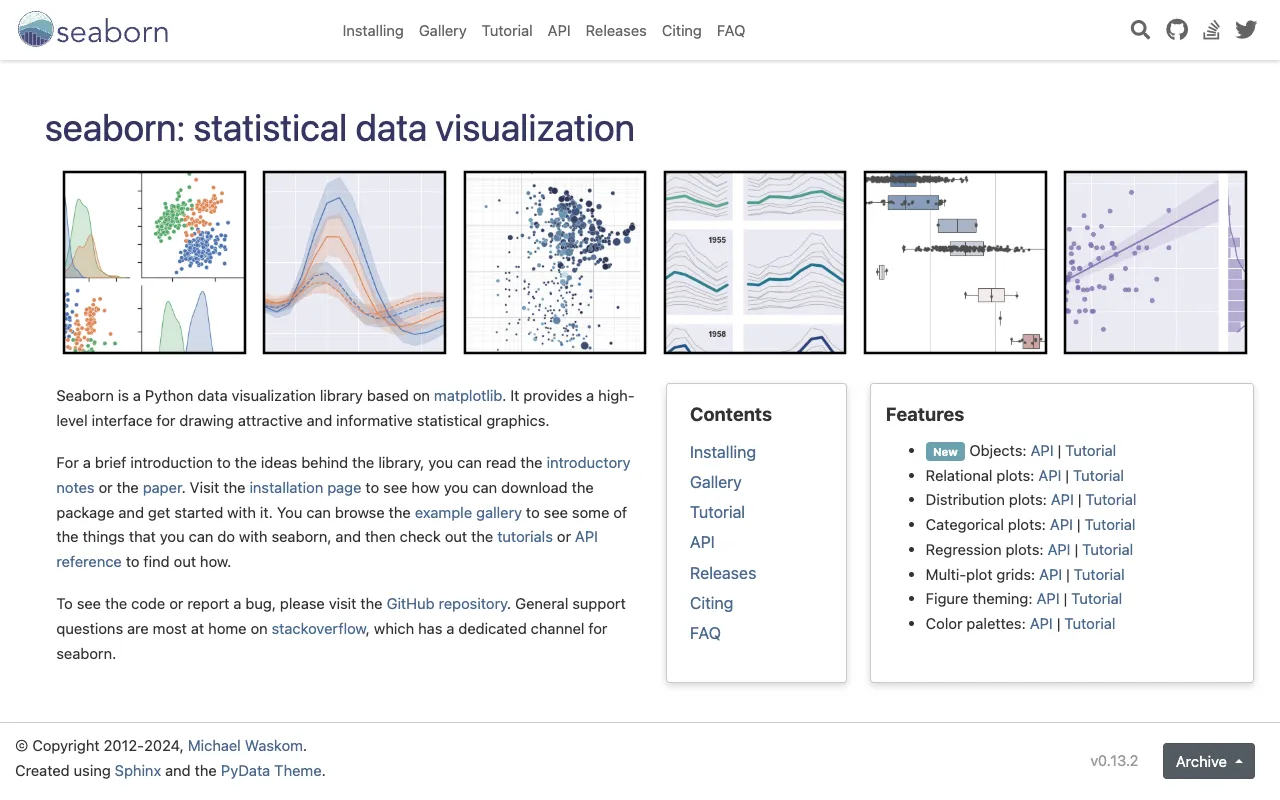
Seaborn is a powerful, open-source Python library designed specifically for statistical data visualization. Built on top of Matplotlib, Seaborn provides a high-level, declarative interface that allows data scientists, analysts, and researchers to create beautiful, informative, and publication-quality plots with minimal code. It simplifies complex visualization tasks, offers elegant default styles, and integrates seamlessly with pandas DataFrames, making it the go-to choice for exploratory data analysis (EDA) and communicating data insights effectively.
What is the Seaborn Python Library?
Seaborn is a specialized Python visualization library focused on statistical graphics. Unlike general-purpose plotting libraries, Seaborn is designed with data science workflows in mind. It understands the structure of your data, often stored in pandas DataFrames, and provides functions that map data variables to visual elements (like color, hue, and style) automatically. Its core purpose is to make it easy to visualize complex datasets and uncover the underlying patterns, distributions, and relationships. It's the tool of choice when you need to move beyond basic charts to sophisticated visualizations like violin plots, pair plots, joint distributions, and regression models with built-in statistical estimation.
Key Features of Seaborn for Data Science
High-Level, Declarative API
Seaborn's greatest strength is its simplicity. With just one or two lines of code, you can create complex visualizations that would require many lines of verbose Matplotlib code. You declare what you want to plot (e.g., a relationship between two variables, faceted by a third) and Seaborn handles the intricate plotting logic, statistical aggregation, and aesthetic styling automatically.
Built-in Statistical Plotting
Seaborn comes with functions tailored for statistical analysis. This includes `lmplot()` and `regplot()` for visualizing linear relationships with confidence intervals, `distplot()`/`histplot()`/`kdeplot()` for exploring univariate and bivariate distributions, and `violinplot()`/`boxplot()` for comparing distributions across categories. It seamlessly integrates statistical estimation into the visualization process.
Beautiful Default Themes and Styles
Seaborn provides several sophisticated built-in themes (like `darkgrid`, `whitegrid`, `dark`, `white`, and `ticks`) and a rich, curated color palette system (`color_palette()`). These defaults are designed to be aesthetically pleasing and highly readable for both on-screen analysis and academic publication, saving you hours of manual styling work.
Pandas DataFrame Integration
Seaborn is built for the pandas ecosystem. Most functions accept column names from a DataFrame directly, making your code clean and readable. This tight integration allows for intuitive specification of data variables, grouping, and faceting, streamlining the workflow from data manipulation to visualization.
Multi-Plot Grids (Faceting)
The `FacetGrid` and `PairGrid` objects allow you to create complex multi-plot grids with ease. You can visualize subsets of your data across rows and columns (faceting) or create a matrix of relationships between all variables in a dataset (pair plots), which is invaluable for high-dimensional data exploration.
Who Should Use the Seaborn Library?
Seaborn is an essential tool for anyone working with data in Python who needs to understand and communicate findings visually. Its primary audience is **Data Scientists and Machine Learning Engineers** for Exploratory Data Analysis (EDA) and model diagnostics. **Data Analysts and Business Intelligence Professionals** use it to create clear, compelling reports and dashboards. **Academic Researchers and Students** in fields like statistics, social sciences, and bioinformatics rely on it for generating publication-ready figures. **Python Developers** building data-centric applications also integrate Seaborn for its powerful and simple plotting capabilities. If your work involves finding patterns in data and you use pandas, Seaborn is the natural next step for your visualization needs.
Seaborn Pricing and Free Tier
Seaborn is a 100% free and open-source library distributed under a BSD license. There is no paid tier, subscription, or premium version. It is completely free to use for any purpose, including commercial and academic projects. You can install it via pip (`pip install seaborn`) or conda (`conda install seaborn`) at no cost. Its development is supported by the open-source community, ensuring it remains a powerful, accessible tool for all data professionals.
Common Use Cases
- Exploratory Data Analysis (EDA) for machine learning projects
- Creating correlation matrices and pair plots to identify variable relationships
- Visualizing statistical model fits and regression results with confidence intervals
- Generating publication-quality figures for academic papers and reports
- Building internal dashboards and data stories for business stakeholders
Key Benefits
- Dramatically reduce the code and time required to create complex statistical plots.
- Improve the clarity and impact of your data storytelling with professional, readable visuals.
- Accelerate the data discovery phase of any project by quickly visualizing distributions and relationships.
- Enhance collaboration by producing standardized, high-quality graphics that are easily understood.
Pros & Cons
Pros
- Extremely intuitive and high-level API that boosts productivity.
- Produces beautiful, publication-ready graphics with minimal effort.
- Deep integration with pandas for a seamless data science workflow.
- Powerful built-in statistical plotting functions not found in base Matplotlib.
- Completely free and open-source with a permissive license.
Cons
- Being a high-level wrapper, it offers less low-level customization control than Matplotlib for highly specialized plots.
- Some advanced or non-statistical custom visualizations might still require dropping down to Matplotlib commands.
- Performance can be slower than Matplotlib for rendering extremely large datasets (tens of thousands of points or more).
Frequently Asked Questions
Is Seaborn free to use?
Yes, Seaborn is completely free and open-source. It is distributed under a BSD license, which means you can use it freely for personal, commercial, and academic projects without any cost or licensing fees.
What is the difference between Seaborn and Matplotlib?
Matplotlib is a comprehensive, low-level plotting library that gives you extensive control over every detail of a figure. Seaborn is a high-level interface built on top of Matplotlib. It simplifies the creation of complex statistical graphics by providing smarter defaults, built-in statistical functions, and a more pandas-friendly API, while still allowing you to use Matplotlib for final tweaks if needed.
Do I need to know Matplotlib to use Seaborn?
While you can start using Seaborn's basic functions without deep Matplotlib knowledge, a foundational understanding of Matplotlib is highly beneficial. Since Seaborn objects are Matplotlib objects under the hood, knowing Matplotlib helps with advanced customization of axes, labels, and figure properties, giving you the full power of both libraries.
Is Seaborn good for data science and machine learning?
Absolutely. Seaborn is one of the most recommended libraries for the exploratory data analysis (EDA) phase of data science and ML projects. Its ability to quickly visualize distributions, correlations, and relationships between variables is invaluable for understanding your data, checking assumptions, and communicating insights before and after model building.
Conclusion
For data scientists, analysts, and researchers working in Python, Seaborn is not just a visualization library—it's a productivity multiplier and an essential component of the modern data stack. It masterfully bridges the gap between the raw power of Matplotlib and the need for quick, beautiful, and statistically-informed graphics. By dramatically reducing the code complexity for advanced plots, Seaborn allows you to focus on what matters most: understanding your data. If your work involves exploring patterns, telling stories with data, or presenting findings, integrating Seaborn into your workflow is a decision that pays immediate dividends in clarity, efficiency, and visual impact.