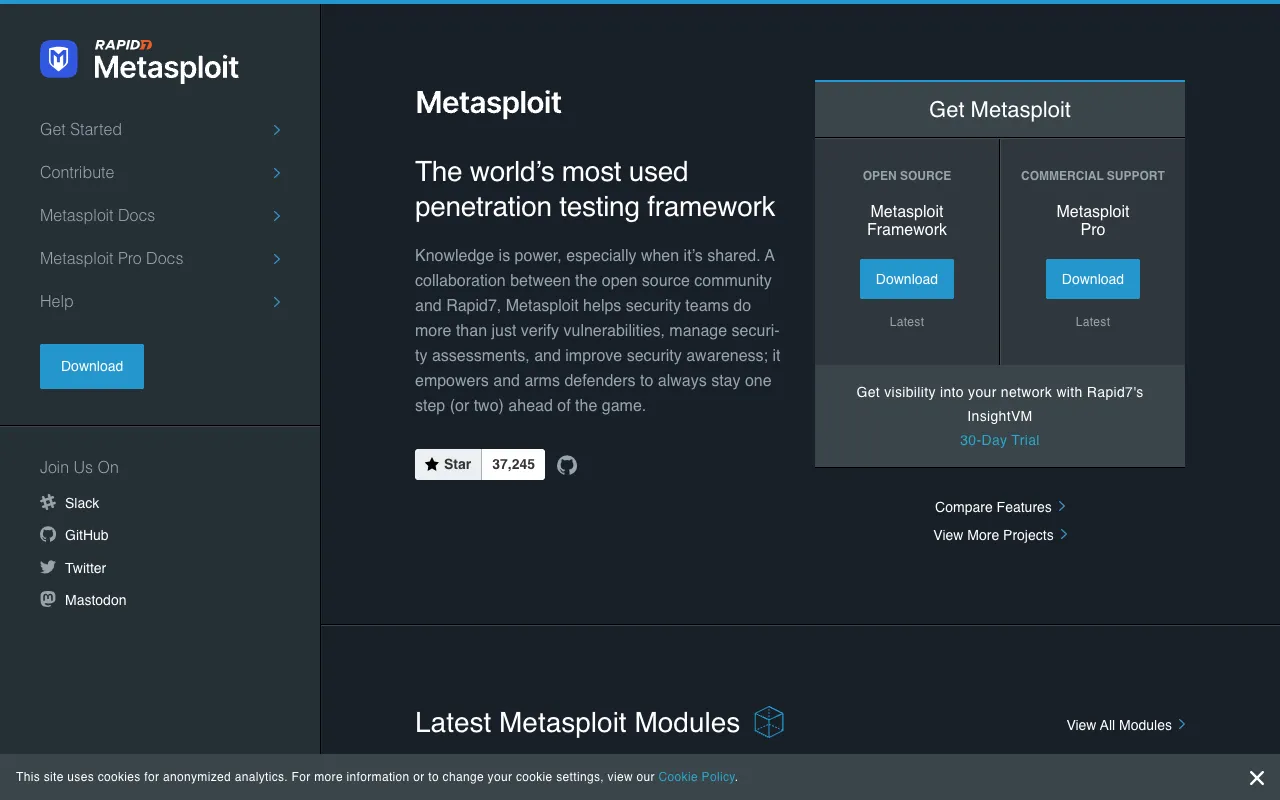
Metasploit – The Essential Penetration Testing Framework for Cybersecurity Experts
Metasploit is the world's most widely used penetration testing framework, providing cybersecurity professionals, ethical hackers, and security researchers with a comprehensive platform for vulnerability assessment, exploit development, and security validation. As an open-source project with commercial extensions, it serves as the backbone for modern penetration testing, enabling experts to simulate real-world attacks, identify security weaknesses, and verify defensive measures effectively. Its modular architecture and extensive exploit database make it an indispensable tool for anyone serious about offensive security.
NutterTools: Curated Gallery of Premium Image & Video Generation Models 🎨
Explore NutterTools, a carefully curated gallery showcasing the best AI image and video generation models available today — from Stable Diffusion and DALL-E to Sora, Runway, Pika, Midjourney, and beyond.
Discover, compare, and generate stunning visuals and dynamic videos with the most advanced image and video generation models in one place
What is the Metasploit Framework?
The Metasploit Framework is a robust, open-source development platform that provides the infrastructure, tools, and content needed to perform penetration testing and vulnerability research. At its core, it's a collection of exploits, payloads, encoders, no-operation generators (NOPs), and auxiliary modules that work together to automate the process of testing security defenses. It allows cybersecurity experts to move beyond theoretical vulnerability knowledge into practical exploitation, providing a controlled environment to safely demonstrate security risks, test patches, and train defensive teams. Its client-server architecture supports collaboration and scalability in complex security engagements.
Key Features of Metasploit for Cybersecurity Testing
Extensive Exploit and Payload Database
Metasploit's greatest strength is its vast, community-driven database of thousands of verified exploits and hundreds of payloads. This library covers a wide range of platforms, applications, and services, from legacy systems to modern web applications and operating systems. The framework simplifies the process of matching a discovered vulnerability with a working exploit, significantly reducing the time from reconnaissance to successful penetration. Payloads can be customized for stealth, persistence, and post-exploitation activities.
Modular Auxiliary and Post-Exploitation Modules
Beyond pure exploitation, Metasploit includes a comprehensive suite of auxiliary modules for scanning, fuzzing, sniffing, and denial-of-service testing. Its post-exploitation modules are particularly powerful, allowing testers to pivot through networks, escalate privileges, gather forensic data (like passwords and system info), and maintain access. This modular approach means security teams can build custom testing workflows that mirror specific threat actor Tactics, Techniques, and Procedures (TTPs).
Integration and Automation via MSFconsole & REST API
The interactive MSFconsole provides a powerful command-line interface for controlling the framework, while the REST API enables integration with other security tools and automation scripts. This allows penetration testers to embed Metasploit capabilities into larger security orchestration platforms, custom reporting tools, or continuous security testing pipelines. Automation scripts can chain exploits, handle payload generation, and manage sessions, making complex multi-stage attacks repeatable and auditable.
Evasion and Anti-Forensics Tools
Modern defenses require sophisticated evasion techniques. Metasploit includes encoders and crypters to help bypass signature-based antivirus and intrusion detection systems. Its Meterpreter payload is a memory-resident, dynamically extensible shell designed to avoid writing to disk, making detection by traditional host-based security products more difficult. These features are critical for testing the effectiveness of endpoint detection and response (EDR) solutions.
Who Should Use the Metasploit Framework?
Metasploit is designed for cybersecurity professionals engaged in offensive security. Its primary users include Penetration Testers and Red Teamers who conduct authorized simulated attacks to evaluate organizational security. Blue Team Defenders and Security Operations Center (SOC) analysts use it to understand attack methodologies and validate their defensive controls and monitoring capabilities. Vulnerability Researchers and exploit developers leverage its modular codebase to prototype and test new vulnerabilities. Finally, it's a foundational educational tool for Cybersecurity Students and professionals pursuing certifications like OSCP, as it provides hands-on experience with real-world exploitation techniques in a legal, controlled environment.
Metasploit Pricing and Free Tier
The core Metasploit Framework is completely free and open-source, licensed under the BSD 3-clause license. This free tier includes the full command-line framework with its exploit database, payloads, and auxiliary modules—more than enough for most penetration testing and educational purposes. For enterprise teams requiring advanced features, Rapid7 offers Metasploit Pro, a commercial product with a graphical user interface (GUI), automated workflows, web application testing, collaboration features, and integrated reporting. Pro is licensed annually based on the number of users. The open-source nature of the core framework ensures it remains accessible to all security professionals, fostering a strong community and continuous development.
Common Use Cases
- Simulating real-world cyber attacks for red team exercises and security posture assessment
- Developing and testing custom exploits for newly discovered software vulnerabilities (CVE)
- Validating the effectiveness of intrusion detection systems (IDS) and antivirus software
- Conducting authorized penetration tests against web applications, networks, and endpoints
- Training cybersecurity teams on attack methodologies and incident response procedures
Key Benefits
- Accelerates the penetration testing lifecycle by providing pre-built, reliable exploits and payloads
- Enhances security team skills through practical, hands-on experience with offensive tools
- Improves organizational security by proactively identifying and demonstrating critical vulnerabilities
- Reduces compliance and audit risk by providing evidence of thorough security testing
- Fosters a deeper understanding of attacker behavior, leading to more effective defensive strategies
Pros & Cons
Pros
- Industry-standard tool with the largest and most current public exploit database
- Completely free and open-source core framework with strong community support
- Highly modular and extensible, allowing for custom tool and module development
- Essential for career advancement in offensive security (e.g., OSCP certification)
- Facilitates reproducible testing and detailed reporting for security audits
Cons
- Steep learning curve requires significant time investment to master effectively
- Powerful capabilities can cause system instability or damage if used without proper authorization and care
- Open-source version lacks the automated workflows and reporting of the commercial Pro edition
- Requires a solid understanding of networking, systems, and vulnerabilities to use effectively
Frequently Asked Questions
Is Metasploit free to use?
Yes, the core Metasploit Framework is completely free and open-source. You can download and use it for penetration testing, vulnerability research, and education without any cost. A commercial version, Metasploit Pro, is available with additional enterprise features like a GUI and automated reporting, but the free version is fully functional for most professional and learning purposes.
Is Metasploit legal?
Metasploit is a legal security tool when used ethically and with proper authorization. Using it to test systems you own, systems you have explicit written permission to test, or in isolated lab environments for education is perfectly legal. Using Metasploit to attack systems without authorization is illegal and constitutes computer fraud. Always ensure you have clear, documented permission before testing any system that you do not own.
What is the difference between Metasploit Framework and Metasploit Pro?
Metasploit Framework is the free, open-source command-line tool used by most security professionals. Metasploit Pro is the commercial edition from Rapid7, which adds a graphical user interface (GUI), advanced automation features like automated penetration testing workflows, integrated web application scanning, team collaboration tools, and professional reporting capabilities. The Framework provides the core exploitation engine, while Pro adds productivity and management features for enterprise teams.
Is Metasploit good for beginners in cybersecurity?
Metasploit is an excellent learning tool for beginners who have a foundational understanding of networking, operating systems, and basic security concepts. It provides tangible, hands-on experience with exploits and vulnerabilities. However, it has a significant learning curve. Beginners should start in controlled, isolated lab environments (like Virtual Machines), follow structured tutorials or courses, and never use it on unauthorized systems. It's a powerful way to bridge the gap between theoretical knowledge and practical offensive security skills.
Conclusion
For cybersecurity professionals committed to mastering offensive security, Metasploit is not just a tool—it's an essential platform. Its unparalleled exploit database, modular architecture, and powerful post-exploitation capabilities make it the definitive choice for penetration testing, vulnerability validation, and security research. While it demands respect and a commitment to learning, the skills developed with Metasploit directly translate to a deeper, more practical understanding of cyber threats. Whether you're conducting an authorized penetration test, researching a new CVE, or building your red team skills, the free and open-source Metasploit Framework provides the proven, professional-grade capabilities needed to excel. It remains the cornerstone tool for anyone serious about understanding and defending against modern cyber attacks.