Go back
Image of Scikit-learn – The Essential Machine Learning Library for Data Scientists

Scikit-learn – The Essential Machine Learning Library for Data Scientists

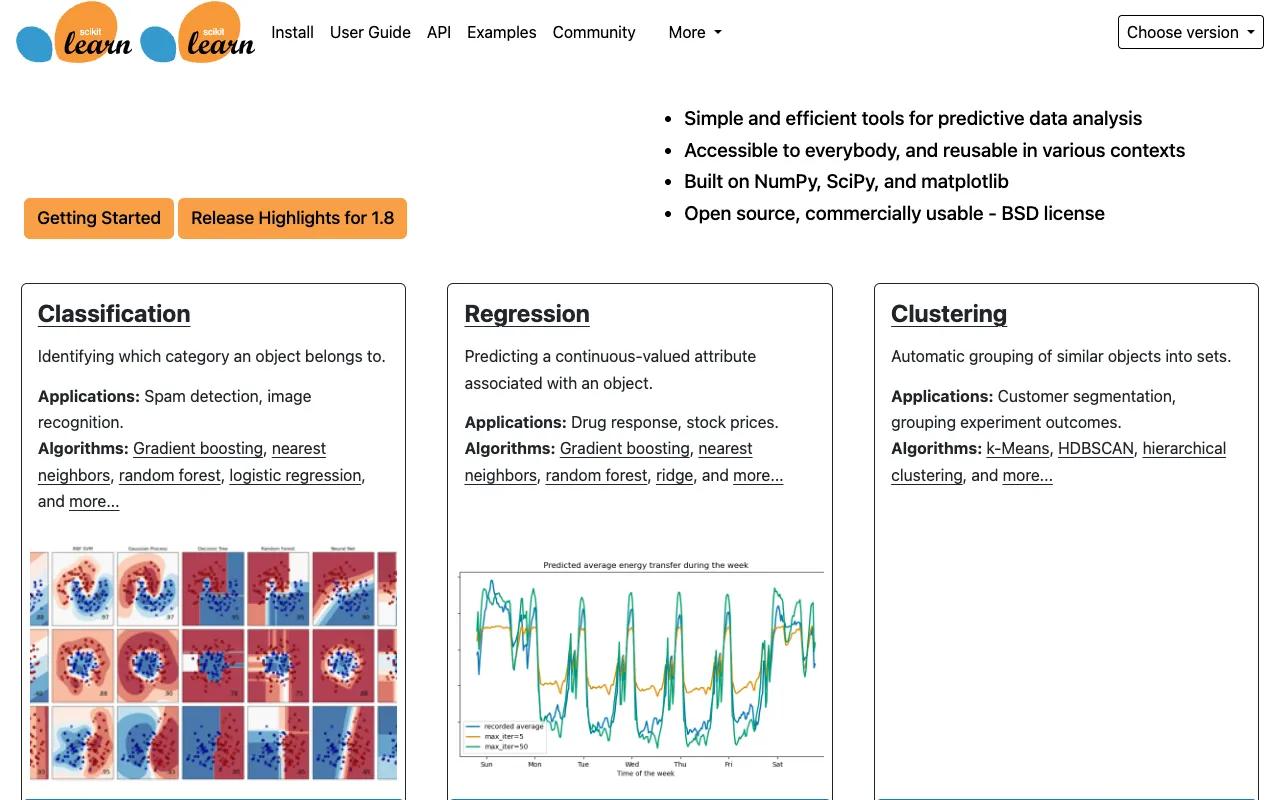
Scikit-learn is the cornerstone of practical machine learning in Python. As the most widely adopted library for predictive data analysis, it provides data scientists with a consistent, intuitive API for implementing a vast array of classification, regression, and clustering algorithms. Built on the solid foundations of NumPy, SciPy, and Matplotlib, Scikit-learn transforms complex statistical modeling into accessible, efficient workflows, making it the first choice for prototyping, research, and production-level ML applications.

What is Scikit-learn?

Scikit-learn is a comprehensive, open-source Python library designed specifically for machine learning and statistical modeling. Its primary purpose is to provide accessible and efficient tools for predictive data analysis, serving as the practical implementation bridge between statistical theory and real-world data science projects. The library is built for a broad audience, from students and academic researchers to industry data scientists and ML engineers, offering a unified interface that simplifies the entire ML pipeline—from data preprocessing and model selection to training, evaluation, and deployment.

Key Features of Scikit-learn

Unified API for Consistent Modeling

Scikit-learn's greatest strength is its consistent estimator API. Whether you're using a linear regression, a support vector machine, or a random forest, the methods `.fit()`, `.predict()`, and `.score()` work identically. This dramatically reduces the learning curve and code complexity, allowing data scientists to rapidly experiment with and compare dozens of algorithms without rewriting their workflow.

Comprehensive Algorithm Library

The library offers a vast, battle-tested collection of supervised and unsupervised learning algorithms. This includes everything from classic linear models and support vector machines to ensemble methods like Random Forests and Gradient Boosting, alongside clustering algorithms like K-Means and DBSCAN. This 'one-stop-shop' approach eliminates the need to integrate multiple specialized packages for most common ML tasks.

Integrated Model Selection & Evaluation Tools

Scikit-learn provides built-in utilities for critical steps in the ML lifecycle. This includes tools for cross-validation (like `cross_val_score` and `GridSearchCV`), hyperparameter tuning, and a full suite of metrics for model evaluation (accuracy, precision, recall, F1-score, ROC-AUC, etc.). These integrated features ensure robust model development and prevent common evaluation pitfalls.

Seamless Data Preprocessing Pipeline

Beyond algorithms, Scikit-learn excels at data preparation through its `preprocessing` and `decomposition` modules. It offers scalable solutions for feature scaling (StandardScaler, MinMaxScaler), encoding categorical variables (OneHotEncoder), handling missing values (SimpleImputer), and dimensionality reduction (PCA, t-SNE). The `Pipeline` object allows you to chain these preprocessing steps with an estimator, creating reproducible and deployable workflows.

Who Should Use Scikit-learn?

Scikit-learn is the ideal tool for anyone working on machine learning projects within the Python ecosystem. It is indispensable for **Data Scientists** prototyping and validating models, **ML Engineers** building production pipelines, **Academic Researchers** requiring reproducible experiments, and **Students** learning applied machine learning. Its use cases span industries from finance (for fraud detection and risk modeling) and healthcare (for patient outcome prediction) to e-commerce (for recommendation systems and customer segmentation) and any field requiring data-driven prediction or pattern discovery.

Scikit-learn Pricing and Free Tier

Scikit-learn is completely **free and open-source** software released under the BSD license. There is no paid tier, subscription, or premium version. The entire library—including all algorithms, preprocessing tools, and utilities—is available for commercial and non-commercial use at zero cost. Development is supported by a large community of contributors and organizations, ensuring its ongoing maintenance and improvement as a public good for the data science community.

Common Use Cases

Key Benefits

Pros & Cons

Pros

  • Industry-standard library with unparalleled community support and extensive documentation.
  • Exceptionally well-designed, consistent API that dramatically simplifies the machine learning workflow.
  • Comprehensive coverage of essential ML algorithms and data preprocessing techniques in one package.
  • Completely free and open-source with a permissive license for any use case.

Cons

  • Primarily focused on classical machine learning (tabular data); not a framework for deep learning (use TensorFlow/PyTorch for neural networks).
  • Limited native support for very large datasets that don't fit in memory; may require integration with other libraries like Dask.
  • While excellent for modeling, it is not a full-stack data science platform (data manipulation is best handled by pandas, and visualization by matplotlib/seaborn).

Frequently Asked Questions

Is Scikit-learn free to use?

Yes, absolutely. Scikit-learn is 100% free and open-source software released under a BSD license. You can use it for personal, academic, or commercial projects without any cost or licensing fees.

Is Scikit-learn good for deep learning?

No, Scikit-learn is not designed for deep learning. It excels at classical machine learning algorithms for tabular data (like linear models, SVMs, tree-based ensembles). For deep learning tasks involving neural networks (e.g., computer vision, NLP), you should use dedicated frameworks like TensorFlow, PyTorch, or Keras.

What is the main advantage of using Scikit-learn?

The main advantage is its unified and consistent API, which makes the entire machine learning process—from trying different algorithms to evaluating and tuning them—incredibly efficient and less error-prone. This consistency is why it's the default starting point for most ML projects in Python.

How does Scikit-learn compare to other data science tools?

Scikit-learn specializes in machine learning modeling. It is typically used alongside pandas for data manipulation, NumPy for numerical computation, and matplotlib/seaborn for visualization. It complements rather than replaces these libraries, forming the core of the Python data science stack for predictive analytics.

Conclusion

Scikit-learn remains the undisputed foundation for applied machine learning in Python. For data scientists tackling predictive analytics, classification, regression, or clustering problems, it offers an unmatched combination of accessibility, robustness, and comprehensive tooling. Its free, open-source nature and vibrant community ensure it will continue to evolve as an essential resource. Whether you're building your first model or deploying a complex pipeline to production, Scikit-learn provides the reliable, efficient, and well-documented toolkit you need to succeed.