Go back
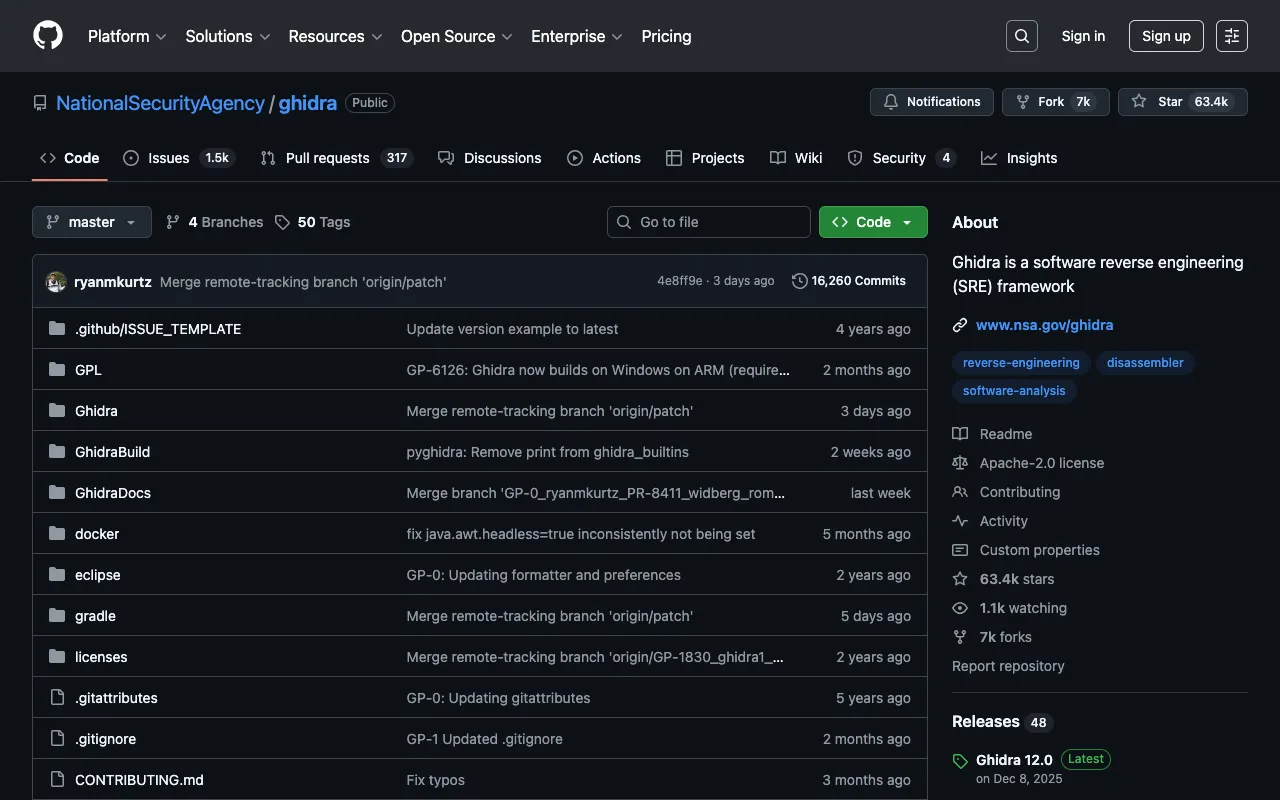
Image of Ghidra – NSA's Reverse Engineering Suite for Cybersecurity Experts

Ghidra – NSA's Reverse Engineering Suite for Cybersecurity Experts

Ghidra is a professional-grade, open-source software reverse engineering (SRE) framework originally developed by the National Security Agency's (NSA) Research Directorate. Released to the public in 2019, it has become an indispensable tool for cybersecurity analysts, malware researchers, and software security engineers. Ghidra enables experts to disassemble, decompile, analyze, and debug compiled code from a wide range of processor instruction sets and executable formats, providing deep visibility into how software—including malicious code—operates at its core.

What is Ghidra?

Ghidra is a complete software reverse engineering suite built for deep, interactive analysis of compiled programs. Unlike basic disassemblers, Ghidra provides a collaborative, feature-rich environment where security researchers can take apart binaries, understand their functionality, identify vulnerabilities, and analyze malicious software (malware). Its core capability lies in transforming machine code—the ones and zeros a CPU executes—back into a human-readable representation, complete with inferred data types, function signatures, and control flow. Originally an internal NSA tool, its public release represents a significant contribution to the global cybersecurity community, offering capabilities that rival expensive commercial alternatives.

Key Features of Ghidra

Powerful Decompiler

Ghidra's flagship feature is its robust decompiler, which transforms assembly code back into readable, compilable C-like pseudocode. This dramatically accelerates analysis by abstracting away low-level processor instructions, allowing researchers to focus on logic, algorithms, and potential security flaws rather than raw opcodes.

Cross-Platform and Multi-Architecture Support

Analyze binaries for x86, ARM, MIPS, PowerPC, and dozens of other processor architectures. Ghidra supports a vast array of executable formats (PE, ELF, Mach-O) and operating systems, making it a universal tool for analyzing malware or software from any source.

Scripting and Extensibility

Automate repetitive analysis tasks or build custom tools using Ghidra's extensive API. It supports scripting in Java and Python, allowing teams to develop and share plugins, analyzers, and scripts to tailor the environment to specific research workflows or threat landscapes.

Collaborative Reverse Engineering

Multiple analysts can work on the same reverse engineering project simultaneously. Ghidra's built-in version tracking and project sharing features facilitate teamwork on complex malware analysis or vulnerability research, enabling knowledge sharing and parallel investigation.

Graphing and Visualization

Automatically generate control flow graphs, call graphs, and data references. Visualizing the relationships between functions and code blocks is crucial for understanding program logic and identifying complex code paths often used in obfuscated malware.

Who Should Use Ghidra?

Ghidra is designed for professional cybersecurity practitioners. Its primary users include Malware Analysts dissecting ransomware, trojans, and exploits; Vulnerability Researchers hunting for bugs in software and firmware; Security Engineers performing product security assessments or analyzing third-party software; and Digital Forensics Experts examining suspicious binaries during incident response. It is also an excellent educational tool for students and aspiring security professionals looking to master the art of reverse engineering in a powerful, cost-free environment.

Ghidra Pricing and Free Tier

Ghidra is completely free and open-source software released under the Apache License 2.0. There is no paid tier, subscription, or enterprise version. The entire feature set—including the decompiler, collaborative features, and scripting engine—is available at no cost. This makes it an exceptionally powerful and accessible tool for individuals, academic institutions, non-profits, and corporations alike. Development is managed as an open-source project, with contributions from the NSA and the broader security community.

Common Use Cases

Key Benefits

Pros & Cons

Pros

  • Completely free and open-source with no feature restrictions
  • Industrial-strength decompiler produces highly readable pseudocode
  • Extensive support for processor architectures and file formats
  • Powerful scripting and plugin architecture for automation
  • Facilitates team-based collaborative analysis

Cons

  • Has a steeper learning curve compared to simpler disassemblers, requiring time investment
  • The user interface can feel less polished than some commercial alternatives
  • Being a Java application, it can be memory-intensive when analyzing very large binaries

Frequently Asked Questions

Is Ghidra free to use?

Yes, Ghidra is 100% free and open-source software. It was released to the public by the NSA and is licensed under the Apache License 2.0. There are no hidden costs, paid upgrades, or feature-limited versions.

Is Ghidra good for malware analysis?

Absolutely. Ghidra is one of the premier tools for malware analysis. Its powerful decompiler, graphing capabilities, and scripting allow analysts to efficiently dissect sophisticated malware, understand its behavior, and extract indicators of compromise (IOCs). Its origins within the NSA underscore its suitability for high-stakes security research.

How does Ghidra compare to IDA Pro?

Ghidra is widely considered the most capable free alternative to the commercial IDA Pro. While IDA Pro has a longer history and some advanced features, Ghidra's decompiler is highly competitive, and its collaborative features and zero cost make it an exceptional choice for many security teams and individual researchers.

What skills do I need to start using Ghidra?

A solid foundation in programming (especially C/C++) and an understanding of computer architecture (assembly language, memory, CPU registers) are essential. Familiarity with software security concepts is also highly beneficial. While powerful, Ghidra is a professional tool that requires dedicated study to master.

Conclusion

For cybersecurity professionals engaged in reverse engineering, malware analysis, or vulnerability research, Ghidra is not just a tool—it's a force multiplier. By providing NSA-grade capabilities for free, it has democratized deep binary analysis, empowering security teams worldwide. Its combination of a world-class decompiler, extensibility, and collaborative features makes it a top-tier choice for any serious practitioner. Whether you're responding to an active threat, auditing software security, or building your reverse engineering skills, Ghidra is an essential component of a modern cybersecurity toolkit.