BloodHound – The Ultimate Active Directory Attack Path Mapper
BloodHound is a revolutionary, open-source cybersecurity tool that transforms how security professionals defend Active Directory environments. By applying graph theory to AD data, it automatically uncovers hidden, unintended relationships and attack paths that traditional security tools miss. Designed for penetration testers, red teams, and blue teams, BloodHound provides unparalleled visibility into the most critical attack surface in enterprise networks, helping you identify and eliminate vulnerabilities before attackers can exploit them.
What is BloodHound?
BloodHound is a powerful, single-page web application that ingests data from an Active Directory environment and uses graph theory algorithms to map the complex relationships between users, groups, computers, and permissions. It visualizes these relationships, revealing how an attacker could move laterally, escalate privileges, and ultimately compromise domain admin accounts from a seemingly low-level starting point. Unlike static analysis tools, BloodHound dynamically calculates and displays the shortest and most dangerous attack paths, providing actionable intelligence for both offensive security testing and proactive defense.
Key Features of BloodHound
Graph-Based Attack Path Analysis
BloodHound's core engine uses graph theory to model your entire Active Directory as a network of nodes and edges. This allows it to identify complex, chained relationships—like nested group memberships, local admin rights, and ACL modifications—that create exploitable paths for privilege escalation and lateral movement.
Interactive Visual Interface
The intuitive web-based UI presents complex AD topology as an interactive, searchable graph. You can zoom, pan, and click on any user, computer, or group to instantly see all connected attack paths, making it easy to understand and communicate security risks.
Pre-Built and Custom Queries
BloodHound comes with a powerful querying language (Cypher) and pre-built queries to quickly find high-value targets, shortest paths to domain admin, users with excessive rights, and other critical security insights, speeding up both attack simulation and defense auditing.
Data Collection via SharpHound
The companion tool, SharpHound, is the official data collector for BloodHound. Written in C#, it efficiently gathers the necessary AD data (users, groups, sessions, ACLs, etc.) with minimal network footprint and exports it for analysis within the BloodHound interface.
Who Should Use BloodHound?
BloodHound is an essential tool for cybersecurity professionals focused on identity security and Active Directory. **Penetration Testers and Red Teams** use it to efficiently identify and exploit attack paths during engagements, proving real-world risk. **Blue Teams, Security Analysts, and System Administrators** leverage it for proactive defense, auditing their AD environments to find and remediate misconfigurations before they are weaponized. **Security Architects** use its insights to design more secure AD structures and enforce the principle of least privilege.
BloodHound Pricing and Free Tier
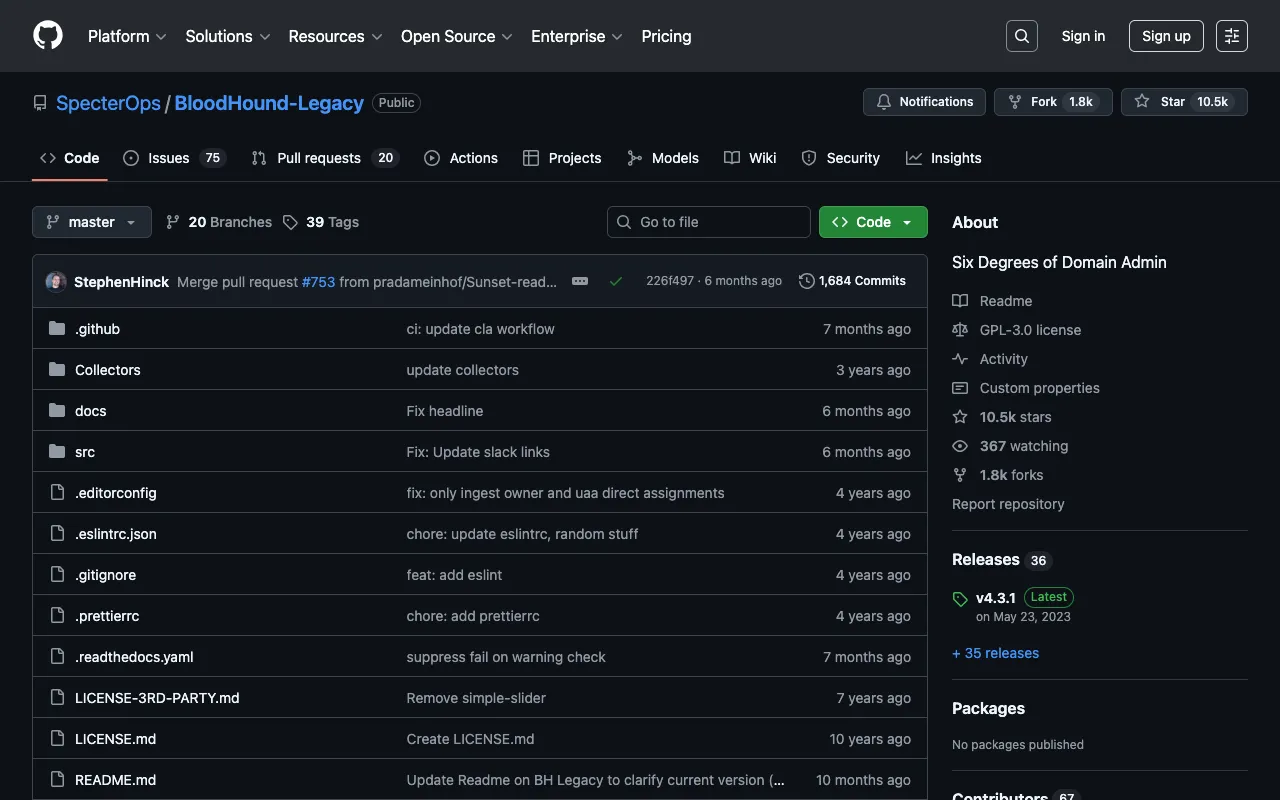
BloodHound is completely **free and open-source**, released under the GNU General Public License v3.0. There is no paid tier, enterprise version, or hidden costs. You can download, use, and modify the source code directly from its official GitHub repository. This commitment to open access has made it a cornerstone tool in the cybersecurity community, empowering defenders and ethical hackers worldwide without financial barriers.
Common Use Cases
- Active Directory penetration testing and red team exercises
- Proactive security auditing and hardening of AD environments
- Identifying and remediating Kerberoastable and AS-REP Roastable accounts
- Visualizing and explaining AD attack paths for executive reports and stakeholder buy-in
Key Benefits
- Dramatically reduces the time to discover critical AD misconfigurations and attack vectors.
- Provides a defender's view of the attack surface, enabling proactive security posture improvement.
- Helps validate the effectiveness of security controls and the principle of least privilege.
Pros & Cons
Pros
- Completely free and open-source with a massive community behind it.
- Unmatched visibility into complex, chained AD attack paths that other tools miss.
- Powerful for both offensive security (attack simulation) and defensive security (auditing).
- Continuously updated with new attack techniques and data collection methods.
Cons
- Requires initial data collection within the target environment, which needs appropriate authorization.
- The graph can become very complex in large enterprise environments, requiring careful analysis.
- Primarily focused on Active Directory; not a general-purpose vulnerability scanner.
Frequently Asked Questions
Is BloodHound free to use?
Yes, BloodHound is 100% free and open-source. You can download, use, and contribute to its development on GitHub without any licensing fees, making it accessible to cybersecurity professionals and organizations of all sizes.
Is BloodHound good for Active Directory security?
BloodHound is considered one of the best and most essential tools for Active Directory security. Its graph-based approach is uniquely effective at revealing the hidden relationships and attack paths that are the root cause of most major AD breaches, making it indispensable for both testing and securing enterprise networks.
What is the difference between BloodHound and SharpHound?
BloodHound is the analysis and visualization engine—the web application you use to explore attack paths. SharpHound is the data collector—the agent you run on systems within the AD domain to gather the user, group, session, and ACL data that BloodHound needs to build its graph. They are companion tools used together.
Can BloodHound be used for defensive purposes?
Absolutely. While popular with red teams, BloodHound is equally powerful for blue teams and defenders. It allows security admins to proactively audit their AD, identify dangerous configurations (like excessive privileges or misconfigured ACLs), and measure their security posture against realistic attack scenarios, enabling them to fix issues before an attacker finds them.
Conclusion
For any cybersecurity professional responsible for the security of an Active Directory environment, BloodHound is not just a tool—it's a fundamental component of a modern security stack. Its ability to translate complex AD permissions and relationships into clear, actionable attack paths is unmatched. By providing this critical visibility for free, BloodHound empowers defenders to think like attackers and secure their identity infrastructure proactively. Whether you're conducting a penetration test, responding to a threat, or hardening your defenses, integrating BloodHound into your workflow is a decisive step towards a more secure network.